
Prediction Market Regulation: Polymarket, Kalshi and Future Trends

Prediction markets have moved from a niche internet experiment into one of the most discussed areas across crypto, finance, and technology. Platforms such as Polymarket and Kalshi have shown that users are increasingly interested in trading future events, not only traditional assets.
However, rapid growth has created a major question: how should prediction markets be regulated?
This article explores prediction market regulation, compares Polymarket and Kalshi, and explains how different regulatory paths may shape the future of event-based markets.
KEY TAKEAWAYS
- Prediction market regulation is becoming one of the biggest discussions in Web3 and financial technology as event-based trading gains mainstream attention.
- Polymarket and Kalshi represent two different regulatory approaches: decentralized blockchain markets and fully regulated event contract exchanges.
- The main debate is not only whether prediction markets are gambling, but how they should fit into existing financial frameworks.
- AI, blockchain settlement, and demand for real-time probability data are creating new opportunities around prediction market infrastructure.
- Future growth will depend on finding the balance between innovation, user protection, and regulatory clarity.
What Are Prediction Markets and Why Do Regulators Care?
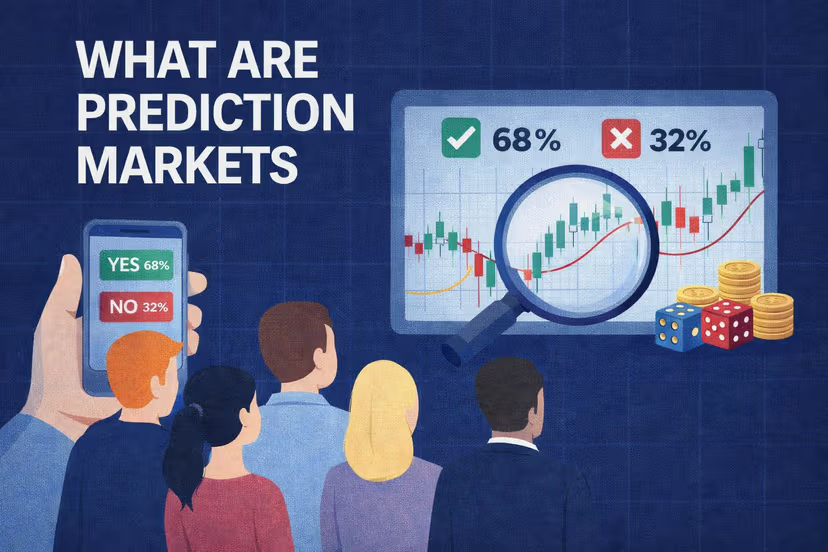
Prediction markets allow users to trade contracts linked to future events.
Unlike stocks or crypto tokens, prediction market contracts do not represent ownership of an asset. Instead, they represent the probability of an outcome.
For example:
A market may ask:
“Will a central bank cut interest rates this year?”
Users can trade:
| Contract | Settlement |
|---|---|
| YES | Pays if the event happens |
| NO | Pays if the event does not happen |
The contract price reflects market expectations.
If YES trades at $0.65, participants are roughly pricing a 65% chance of that outcome.
This probability-based structure is exactly why regulators debate classification. Prediction markets share characteristics with derivatives, information platforms, and gambling products.
Prediction Market Regulation: Three Main Global Approaches
There is no single worldwide framework for prediction markets.
Different jurisdictions classify them based on how the product works, who operates it, and how users interact with funds.
The current regulatory approaches generally fall into three categories.
Financial Derivatives Regulation
Some regulators treat prediction markets as event-based financial contracts.
The United States provides one of the clearest examples.
Under this approach, certain event contracts may fall under the oversight of the Commodity Futures Trading Commission (CFTC).
Kalshi follows this model.
As a CFTC-regulated Designated Contract Market (DCM), Kalshi operates within a formal financial regulatory framework.
This approach provides clearer rules but also creates limitations around market listings, compliance requirements, and operational flexibility.
Gambling and Betting Regulation
Other jurisdictions view prediction markets closer to betting products.
The reasoning is simple:
Users risk money based on uncertain future outcomes.
Under this model, platforms may require gambling licenses and must follow rules designed for wagering operators.
This creates a major challenge for global platforms because the same prediction market can be viewed as financial innovation in one country and restricted betting activity in another.
Regulatory Gray Areas
Many prediction markets exist between traditional categories.
They may involve:
- Financial-style contracts
- User-generated information
- Blockchain settlement
- Global participation
This creates overlapping questions involving financial regulators, gambling authorities, and consumer protection agencies.
Polymarket is one of the most important examples of this regulatory complexity.
Polymarket Regulation Explained: The Web3 Approach
Polymarket became one of the most recognized decentralized prediction markets by combining event trading with blockchain infrastructure.
Its model focuses on:
- Crypto-based transactions
- Transparent market activity
- Global accessibility
- Blockchain settlement systems
However, decentralization does not remove regulatory considerations.
In 2022, the U.S. Commodity Futures Trading Commission announced a $1.4 million settlement with Polymarket for operating an unregistered event-based binary options market.
Following the settlement, Polymarket restricted access for U.S. users and continued expanding its international presence.
The case demonstrated an important lesson:
Regulators usually evaluate what a platform actually does, not only what technology it uses.
Kalshi Regulation Explained: The Compliance-First Model
Kalshi represents a very different strategy.
Instead of avoiding traditional financial regulation, Kalshi built its platform around regulatory approval.
By becoming a CFTC-regulated exchange, Kalshi created a legal framework for certain event contracts.
The benefits include:
- Greater regulatory certainty
- Institutional accessibility
- More traditional financial market structure
However, regulated markets also face restrictions.
Every market category, contract design, and expansion strategy may require careful compliance review.
Kalshi prioritizes regulatory acceptance, while Polymarket prioritizes open-market accessibility.
Polymarket vs Kalshi: Different Paths for Prediction Markets
The difference between Polymarket and Kalshi reflects a larger industry debate.
Should prediction markets become internet-native information networks?
Or should they become regulated financial exchanges?
| Category | Polymarket | Kalshi |
|---|---|---|
| Model | Decentralized prediction market | Regulated event exchange |
| Technology | Blockchain infrastructure | Traditional financial system |
| Regulatory Approach | International Web3 structure | CFTC compliance model |
| User Base | Crypto-native users | Finance-focused users |
| Main Challenge | Regulatory uncertainty | Product restrictions |
Both models solve different problems, and the future market may include both approaches.
Why Prediction Markets Are Growing Now
Prediction markets are gaining attention because uncertainty has become increasingly valuable.
Modern markets are influenced by:
- Interest rate decisions
- Elections
- Regulation changes
- Technology trends
- Global events
Traditional analysis often depends on opinions.
Prediction markets introduce financial incentives.
Participants who believe prices are incorrect can trade, pushing information into market prices.
This turns scattered opinions into measurable probability signals.
AI and Prediction Market Regulation
AI is another reason prediction markets are attracting attention.
AI systems are effective at:
- Processing large datasets
- Summarizing information
- Comparing scenarios
Prediction markets provide something different:
A probability signal created by economic participation.
The combination of AI and prediction markets may support:
- Event analysis tools
- Market intelligence platforms
- Probability dashboards
- Research products
However, AI-powered trading introduces new questions.
There is a major difference between AI helping users understand information and AI automatically making financial decisions.
Future regulation may focus heavily on this boundary.
Startup Opportunities in Prediction Markets
The prediction market ecosystem is expanding beyond trading platforms.
Some of the strongest opportunities may appear in supporting infrastructure.
Information and Data Tools
Lower-risk areas often focus on organizing information rather than executing trades.
Examples include:
- Prediction market analytics
- Market comparison tools
- Data visualization platforms
These products usually function closer to information services.
Strategy and Research Platforms
Prediction markets create demand for:
- Probability analysis
- Arbitrage monitoring
- Market research
The important distinction is whether a platform provides information or directly controls trading decisions.
Execution and Trading Infrastructure
The highest regulatory attention usually appears around:
- Automated trading
- Copy trading
- Fund custody
- User order execution
When platforms influence transactions directly, they may move closer to regulated financial activities.
Future Trends: Where Prediction Market Regulation Is Heading
The future of prediction market regulation will likely focus on function rather than labels.
Regulators may ask:
Does the platform control user assets?
Does it influence investment decisions?
Does it create financial exposure?
Does it manage trading execution?
The answers may determine whether a product is treated as software, a data provider, a broker, or a financial exchange.
Prediction markets will likely continue evolving through both regulated platforms like Kalshi and Web3-based models like Polymarket.
Final Thoughts
Prediction market regulation is becoming more important because these platforms sit between finance, technology, and information systems.
Polymarket shows how blockchain can create open probability markets.
Kalshi shows how event contracts can enter regulated financial infrastructure.
The future may not belong to one model. Instead, prediction markets may develop across multiple layers, including data services, AI analysis tools, and regulated trading environments.
For users exploring crypto market ecosystems, information about WEEX Token (WXT) and programs such as the WEEX welcome bonus can provide additional context on exchange features, user rewards, and digital asset platforms.
FAQ
1. What is prediction market regulation?
Prediction market regulation refers to the legal rules that determine how event-based trading platforms operate. Depending on the country, prediction markets may be treated as derivatives, betting products, or digital platforms.
2. Is Polymarket regulated?
Polymarket operates as a blockchain-based prediction market and has faced regulatory actions in the United States. Its structure differs from fully regulated exchanges such as Kalshi.
3. Why is Kalshi different from Polymarket?
Kalshi follows a regulated financial exchange model under CFTC oversight, while Polymarket uses a Web3-based approach focused on decentralized infrastructure.
4. Are prediction markets considered gambling?
The answer depends on jurisdiction. Some regulators classify certain prediction markets as gambling, while others treat event contracts as financial instruments.
5. What is the future of prediction markets?
The future may include regulated exchanges, decentralized platforms, AI-powered analysis tools, and data services. Regulation will likely shape which models grow fastest.
Disclaimer: This content is provided for general informational and educational purposes only and should not be considered financial, investment, legal, or tax advice. Nothing in this article constitutes an offer, recommendation, solicitation, or invitation to buy, sell, or trade any crypto asset or use any specific service. Crypto assets are highly volatile and involve a high degree of risk. You may lose some or all of the value of your investment and should not invest funds you cannot afford to lose. WEEX services may not be available in all regions and are subject to applicable laws, regulations, and user eligibility requirements. Please carefully assess risks and confirm local requirements before making any financial decisions.
You may also like
Top 4 Altcoins to Buy in July 2026: Top Crypto Picks for Investors
Who Is Jensen Huang? Nvidia CEO's Net Worth, Biography & NVDA Stock Analysis 2026. Is NVDA Stock a Good Buy Right Now?
Polymarket vs Kalshi: The Future of Prediction Markets Explained
Polymarket vs Kalshi: The Future of Prediction Markets Explained
Prediction Market Arbitrage Explained: How Traders Find Profits
How Polymarket Market Making Works: Risks and Profit Strategies
What Is a Prediction Market? Complete 2026 Guide to Polymarket, Kalshi & Crypto Betting Platforms
Nvidia vs Microsoft Stock 2026: Which AI Giant Is the Better Buy in July?
MicroStrategy's STRC Unpegged: Buy the Dip or Brace for Impact?
How to Buy Cryptocurrency on WEEX Exchange 2026: Full Guide
Prediction Market Apps 2026: How Prediction Markets Work? Are They Safe and Legal?
Is Polymarket Legal in India in 2026? Key Legal Updates on Prediction Markets
14 Best Prediction Market Apps in 2026: The Ultimate Guide to Crypto-Native and Regulated Platforms
Can Politicians Rig Election Prediction Markets? The Dark Side of Election Prediction Markets
2026 US Election Odds: Who Leads Right Now on Polymarket and Kalshi?
What Is a Crypto Prediction Market? Key Opportunities in the Prediction Market Sector
Plot twist in the AI race—the next big flex is actually physical infra?
How to Profit on Prediction Market: A Beginner's Guide to Prediction Market
Top 4 Altcoins to Buy in July 2026: Top Crypto Picks for Investors
Who Is Jensen Huang? Nvidia CEO's Net Worth, Biography & NVDA Stock Analysis 2026. Is NVDA Stock a Good Buy Right Now?
Polymarket vs Kalshi: The Future of Prediction Markets Explained
Polymarket vs Kalshi: The Future of Prediction Markets Explained
Prediction Market Arbitrage Explained: How Traders Find Profits
How Polymarket Market Making Works: Risks and Profit Strategies
Contents
Popular coins


