
How Polymarket Market Making Works: Risks and Profit Strategies

Prediction markets have become one of the fastest-growing sectors in Web3 because they transform opinions about future events into tradable probability markets. Instead of simply betting on outcomes, users trade contracts that reflect the market’s collective expectation of whether something will happen.
This article explains how Polymarket market making works, why it is different from casino-style betting, how liquidity providers manage risk, and what strategies are commonly used by prediction market makers. It is designed for crypto beginners, Web3 users, and traders who want to understand the mechanics behind prediction markets.
KEY TAKEAWAYS
- Polymarket market making provides liquidity by allowing traders to buy and sell prediction market positions before an event ends.
- Unlike traditional casinos, prediction markets use user-driven pricing instead of centralized odds controlled by a house.
- Market makers earn through bid-ask spreads, liquidity incentives, and pricing inefficiencies, but they also face major information risks.
- Polymarket uses a CLOB (Central Limit Order Book) model combined with blockchain-based conditional tokens to improve transparency and liquidity.
Successful prediction market making depends on risk control, probability analysis, and fast reaction to new information.
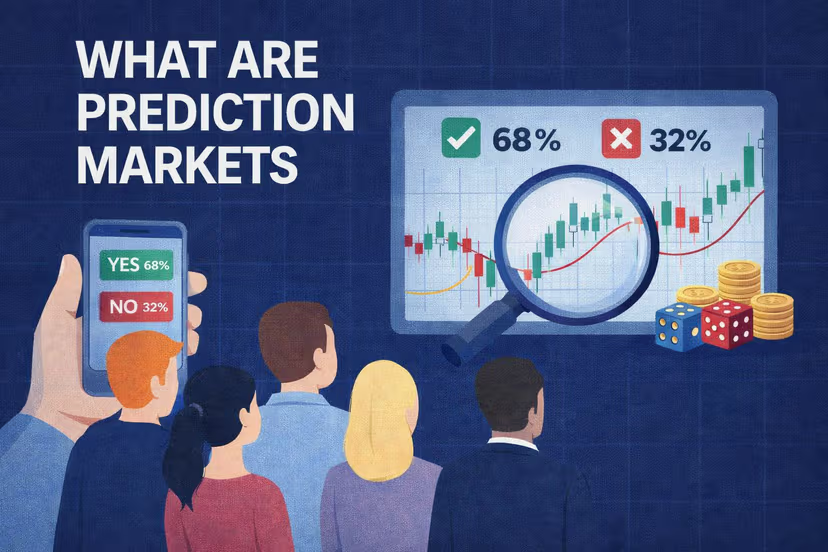
What Is Polymarket Market Making?
Polymarket is a blockchain-based prediction market where users trade event outcome tokens instead of traditional financial assets. These markets usually contain binary outcomes such as “YES” and “NO.”
For example, if a YES token trades at $0.60, the market is roughly implying a 60% probability of that event occurring. The final settlement depends on the real-world outcome.
A market maker’s role is to provide continuous liquidity by placing buy and sell orders. Instead of waiting for another trader, users can enter or exit positions more easily because market makers create available trading depth.
In simple terms:
| Role | Function |
|---|---|
| Traders | Buy or sell predictions based on beliefs |
| Market makers | Provide liquidity and maintain order flow |
| Market price | Represents collective probability expectations |
Market makers do not decide the final probability. They only help the market discover prices more efficiently.
Prediction Market vs Casino: Why Market Making Is Different
Many beginners compare prediction markets with casinos, but the structure is fundamentally different.
A casino operates through centralized odds management. The house controls pricing, accepts bets, limits exposure, and builds a mathematical advantage into every game.
Prediction markets work differently. Prices are created through supply and demand among participants.
| Feature | Casino | Prediction Market |
|---|---|---|
| Pricing | Controlled by operator | Determined by users |
| Counterparty | House vs player | Trader vs trader |
| Liquidity | Provided by casino | Provided by market participants |
| Exit ability | Usually locked | Positions can be traded |
| Revenue model | House edge | Fees and market activity |
This difference changes the role of market makers. A prediction market maker is closer to a liquidity provider in financial markets rather than a traditional gambling operator.
Why Prediction Market Making Is Difficult
Traditional market makers usually earn from spreads. They quote a lower buying price and a higher selling price, collecting the difference when trades occur.
For example:
Buy price: $0.49
Sell price: $0.51
If balanced order flow happens, the market maker captures the spread.
However, prediction markets introduce unique challenges because the underlying asset is information.
Information Risk: The Biggest Problem
In traditional crypto or stock markets, prices move continuously based on many factors.
Prediction markets are different because one piece of information can instantly change the correct probability.
For example, if someone receives reliable information about an event outcome before the market adjusts, they can aggressively trade against existing orders.
This creates adverse selection risk, where informed traders profit while market makers absorb losses.
No Traditional Closing Window
Sportsbooks and casinos often close betting before critical moments. Prediction markets usually remain open until near event resolution.
This creates a challenge:
The closer an event gets to completion, the higher the chance that some traders have better information.
Market makers must constantly update prices instead of relying on fixed odds.
Inventory Risk
Market makers must manage their YES and NO exposure.
Holding too much of one side creates directional risk. If the final result moves against their inventory, spread income may not cover losses.
Professional market makers often adjust quotes dynamically to avoid excessive imbalance.
How Polymarket Uses CLOB for Market Making
Polymarket mainly uses a Central Limit Order Book (CLOB) structure.
A CLOB works similarly to traditional exchanges:
- Users place limit buy and sell orders.
- Orders are matched when prices overlap.
- Market makers provide liquidity by continuously quoting both sides.
Compared with automated pricing models, CLOB allows more efficient price discovery when markets have enough activity.
Advantages include:
| CLOB Benefit | Explanation |
|---|---|
| Transparent pricing | Users see available orders |
| Better efficiency | Competitive traders reduce spreads |
| Flexible strategies | Supports advanced market making models |
The limitation is that inactive markets may struggle with liquidity because there is no automatic counterparty.
AMM and LMSR: Another Prediction Market Liquidity Model
Before order book systems became popular, many prediction markets used automated market makers.
One important model is LMSR (Logarithmic Market Scoring Rule), introduced by economist Robin Hanson.
Unlike order books, LMSR automatically provides prices through a mathematical formula. The system itself becomes the counterparty.
The key parameter is liquidity sensitivity.
Higher liquidity settings create smoother price changes but require more capital. Lower liquidity settings reduce risk but cause larger price movements.
LMSR solves the “empty market” problem because users can trade even without another participant.
However, the system provider must accept potential losses, making risk management essential.
CLOB vs AMM vs Hybrid Prediction Market Models
Modern prediction markets often combine different systems.
| Model | Strength | Weakness |
|---|---|---|
| CLOB | Efficient with active traders | Needs liquidity providers |
| AMM/LMSR | Always available liquidity | Capital risk for system |
| Hybrid Model | Balances both approaches | More complex design |
Hybrid systems can use order books for popular markets while relying on automated liquidity for smaller events.
The goal is always the same: maintain liquidity, reduce price gaps, and control market maker exposure.
Polymarket Market Making Profit Strategies
Market makers usually do not rely on predicting outcomes alone. Their goal is managing probabilities and liquidity.
Common strategies include:
Bid-Ask Spread Capture
Market makers place orders slightly above and below the estimated fair probability.
The profit comes from repeated trading activity rather than guessing the final result.
Dynamic Probability Adjustment
Advanced market makers track external signals, news, and data models.
When new information appears, they adjust quotes quickly to avoid being traded against.
Cross-Market Arbitrage
Sometimes similar prediction markets exist across multiple platforms.
If one market prices an event at 55% probability while another shows 60%, traders may attempt arbitrage opportunities.
Balanced YES/NO Exposure
Market makers often reduce directional risk by balancing outcome token positions.
The objective is not always being right. The objective is surviving volatility while collecting liquidity-based returns.
Is Polymarket Market Making Profitable?
Polymarket market making can generate opportunities, but it is not risk-free.
Unlike traditional exchanges where market makers mainly manage price volatility, prediction markets require understanding information flow.
A profitable strategy usually requires:
- Accurate probability modeling
- Fast reaction speed
- Strong risk controls
- Careful position management
Market makers without information advantages may struggle because informed traders naturally target outdated prices.
Prediction market making is less about being a “casino house” and more about competing in a real-time information market.
Final Thoughts
Polymarket market making represents a new type of Web3 financial infrastructure. By combining prediction markets, liquidity systems, and blockchain settlement, it creates markets where probabilities themselves become tradable assets.
However, liquidity providers face challenges that traditional market makers rarely experience. Information risk, sudden probability changes, and event resolution uncertainty make prediction markets highly competitive.
As the sector grows, better algorithms, AI pricing models, and hybrid liquidity systems may become increasingly important.
FAQ
1. What is Polymarket market making?
Polymarket market making is the process of providing buy and sell liquidity for prediction market contracts. Market makers help users trade more smoothly by reducing price gaps and improving market depth.
2. How do prediction market makers make money?
Prediction market makers mainly earn through bid-ask spreads, liquidity incentives, and pricing inefficiencies. However, profits are not guaranteed because they also face information and inventory risks.
3. Is Polymarket the same as gambling?
Polymarket differs from traditional gambling because prices are created by market participants rather than controlled by a centralized operator. The market functions more like a probability exchange where users trade expectations.
4. What is the difference between CLOB and AMM prediction markets?
CLOB relies on users and market makers placing orders, while AMMs automatically provide liquidity through algorithms. Each model balances liquidity, efficiency, and risk differently.
5. Why is prediction market making risky?
The biggest risk is information imbalance. Traders with faster or better information can trade against outdated market maker prices before adjustments happen.
Disclaimer: This content is provided for general informational and educational purposes only and should not be considered financial, investment, legal, or tax advice. Nothing in this article constitutes an offer, recommendation, solicitation, or invitation to buy, sell, or trade any crypto asset or use any specific service. Crypto assets are highly volatile and involve a high degree of risk. You may lose some or all of the value of your investment and should not invest funds you cannot afford to lose. WEEX services may not be available in all regions and are subject to applicable laws, regulations, and user eligibility requirements. Please carefully assess risks and confirm local requirements before making any financial decisions.
You may also like

Top 4 Altcoins to Buy in July 2026: Top Crypto Picks for Investors
Who Is Jensen Huang? Nvidia CEO's Net Worth, Biography & NVDA Stock Analysis 2026. Is NVDA Stock a Good Buy Right Now?
Prediction Market Regulation: Polymarket, Kalshi and Future Trends
Polymarket vs Kalshi: The Future of Prediction Markets Explained
Polymarket vs Kalshi: The Future of Prediction Markets Explained
Prediction Market Arbitrage Explained: How Traders Find Profits
What Is a Prediction Market? Complete 2026 Guide to Polymarket, Kalshi & Crypto Betting Platforms
Nvidia vs Microsoft Stock 2026: Which AI Giant Is the Better Buy in July?
MicroStrategy's STRC Unpegged: Buy the Dip or Brace for Impact?
How to Buy Cryptocurrency on WEEX Exchange 2026: Full Guide
Prediction Market Apps 2026: How Prediction Markets Work? Are They Safe and Legal?
Is Polymarket Legal in India in 2026? Key Legal Updates on Prediction Markets
14 Best Prediction Market Apps in 2026: The Ultimate Guide to Crypto-Native and Regulated Platforms
Can Politicians Rig Election Prediction Markets? The Dark Side of Election Prediction Markets
2026 US Election Odds: Who Leads Right Now on Polymarket and Kalshi?
What Is a Crypto Prediction Market? Key Opportunities in the Prediction Market Sector
Plot twist in the AI race—the next big flex is actually physical infra?
How to Profit on Prediction Market: A Beginner's Guide to Prediction Market
Top 4 Altcoins to Buy in July 2026: Top Crypto Picks for Investors
Who Is Jensen Huang? Nvidia CEO's Net Worth, Biography & NVDA Stock Analysis 2026. Is NVDA Stock a Good Buy Right Now?
Prediction Market Regulation: Polymarket, Kalshi and Future Trends
Polymarket vs Kalshi: The Future of Prediction Markets Explained
Polymarket vs Kalshi: The Future of Prediction Markets Explained
Prediction Market Arbitrage Explained: How Traders Find Profits
Contents
Popular coins


