
WLFI and Justin Sun: Why This Looks More Like a Governance Scandal Than DeFi

World Liberty Financial (WLFI) was sold to the market as a bold crypto-finance platform with political connections, headline power, and a place in the future of onchain finance. The better reading now is much less flattering. WLFI increasingly looks like a centralized political-financial machine wrapped in DeFi language.
That matters because the Justin Sun dispute did not create WLFI’s core problem. It exposed it. Once Sun accused the project of freezing a large position and using blacklist-style powers against him, the conversation shifted from hype to control. That shift was overdue. The real issue is not whether Sun is sympathetic. The real issue is whether a project marketed in the orbit of Decentralized Finance (DeFi) was ever meaningfully decentralized in the first place.

In my view, this is the heart of the story. Not the personalities. Not the headlines. Not the social media fight. The real story is that WLFI’s documents, economics, and operational structure already pointed to concentrated insider power long before the public freeze dispute exploded.
WLFI Was Built With Insider Control, Not Community Neutrality
The official WLFI gold paper makes one point crystal clear: World Liberty Financial is not a DAO. It says the platform is administered through one or more WLF-controlled multisigs, with signer count and signer identity determined by WLF. That alone strips away the romantic DeFi framing many users still project onto the token.
This is where the project’s branding and its structure start to diverge. A real decentralized system can still have governance friction, but it does not usually reserve so much discretionary operational power at the center. WLFI did.
The project’s economics were just as lopsided. According to the gold paper, DT Marks DEFI LLC received 22.5 billion WLFI tokens and the right to receive 75% of net protocol revenues after specified deductions. That is not a community-first design. It is an extraction-first design. The token may have been marketed with populist financial language, but the cash flow logic was heavily tilted toward affiliated insiders from the beginning.
That is why I do not think the right frame is “unexpected scandal.” The more honest frame is “predictable governance failure.”
The Justin Sun Freeze Did Not Invent the Problem. It Made It Visible.
Justin Sun was not a random user caught in a technical mishap. Public reporting and congressional letters identify him as one of WLFI’s largest known backers, with at least $75 million invested. That is what makes the dispute so revealing. If a project is willing to use blacklist-style controls against one of its biggest strategic supporters, then smaller holders should assume their practical rights are even weaker.
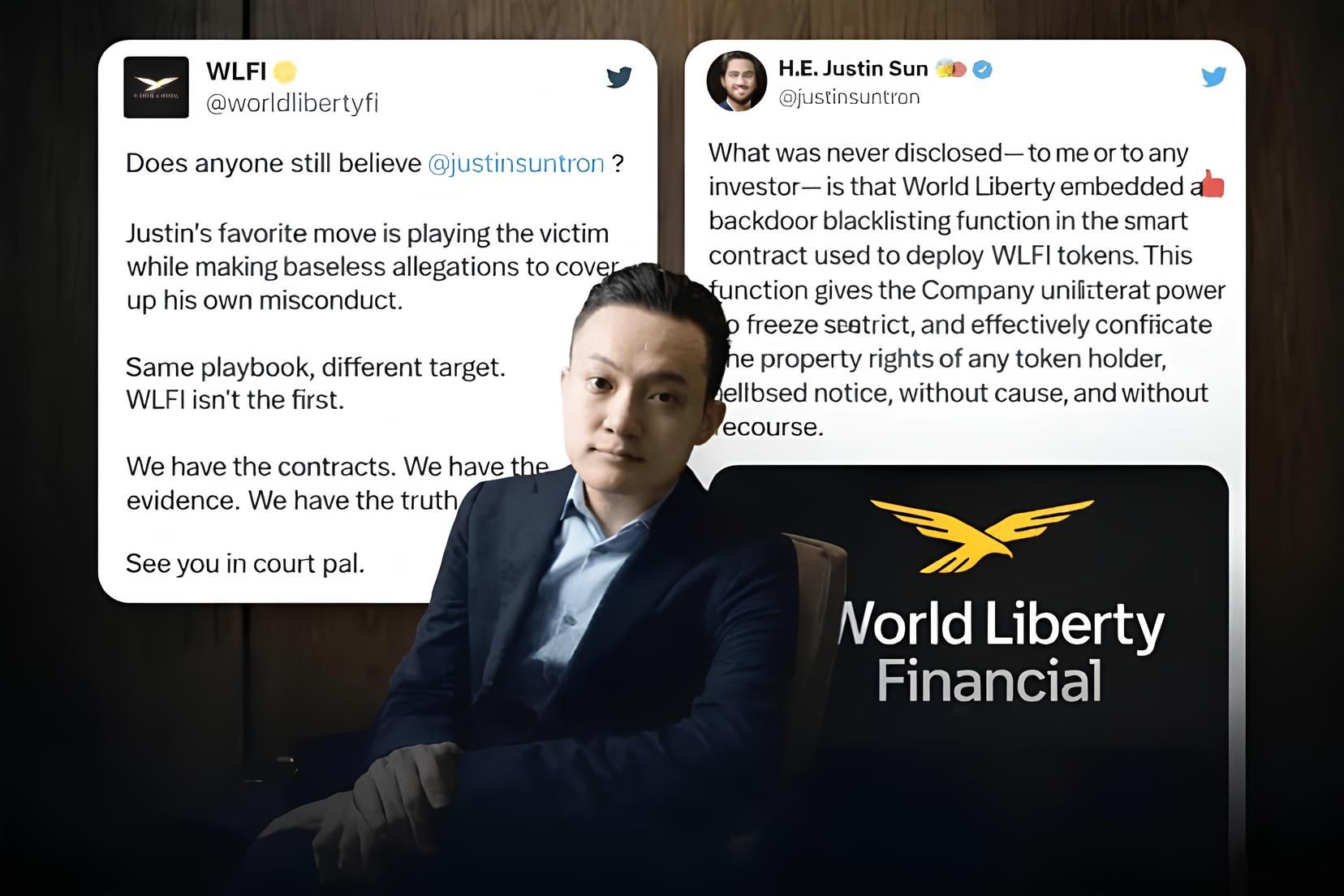
Multiple reports said a Sun-linked address was blacklisted after moving roughly $9 million of WLFI. CoinDesk reported that the address held about $107 million in WLFI at the time it was blacklisted. Reuters similarly reported that Sun said his tokens connected to the project had been frozen. WLFI then escalated the fight publicly rather than defusing it quietly.
That sequence matters because it confirms something many retail buyers learn too late: a token can trade on open markets and still remain subject to admin-level control. If the smart contract contains blacklist logic, pause power, or upgradeable control paths, then “ownership” is not as absolute as the price chart suggests.
In practice, this is where people get trapped. They think they are buying a market asset. Sometimes they are really buying into a hierarchy.
The Trump-Linked Profit Engine Was Never Subtle
One reason the WLFI story keeps getting messier is that the financial incentives were never hard to spot.
The gold paper gives Trump-linked entities extraordinary economics. Forbes later reported that Donald Trump disclosed about $57.4 million in income from World Liberty Financial for the period covered by his 2025 disclosure. Reuters then reported that the Trump family’s stake in the project had already made them hundreds of millions of dollars through their cut of token sales.
This distinction matters:
contractual entitlement is one thing
realized income is another
political influence layered on top of both is something else again
The conservative takeaway is already severe enough without inflating the numbers. Trump-linked entities had rights to the majority of protocol revenue, disclosed tens of millions in real income, and stood to benefit from a token structure whose economics heavily favored insiders over ordinary holders. That is not a side detail. It is the project’s operating logic.
The sharper judgment is that WLFI was designed to monetize attention and access first, and only then ask the market to treat it like infrastructure.
Market Value and Holder Statistics Tell a Less Impressive Story Than the Branding
The market data around WLFI is useful, but only if you read it correctly. A lot of people see a large fully diluted value and assume the market has validated the project. That is lazy analysis.
The better question is how much of that value is actually durable once you account for float, unlocks, insider economics, and administrative control.
| Metric | Public Snapshot | Why It Matters |
|---|---|---|
| Total WLFI supply | 100 billion tokens | Huge supply makes dilution and valuation framing critical |
| Approx. WLFI price in April 2026 | About $0.08013 | Shows how far the token has fallen from early post-listing enthusiasm |
| Implied fully diluted value | Roughly $8 billion at that price | Sounds impressive, but FDV overstates real exit value when float is thin and control is concentrated |
| Public holder snapshot | More than 80,000 holders; one widely cited USD1 distribution referenced 85,106 WLFI holders | Holder count looks broad, but broad ownership does not equal fair power distribution |
| Justin Sun-linked frozen position | About $107 million at the time of blacklisting, according to CoinDesk reporting | Confirms the freeze affected a major strategic holder, not a trivial wallet |
| Price drawdown after trading began | More than 74% in some public reporting | Retail damage was real, not theoretical |
This is the kind of table that makes WLFI easier to read. Yes, the project built a big holder base. Yes, the token achieved a large paper valuation. But a high holder count does not prove decentralization, and a high FDV does not prove quality. In WLFI’s case, both can actually mask fragility.
That is one of the oldest traps in crypto. A token can look big and still be structurally weak.
What Holders Usually Miss
Most people lose money in projects like this for boring reasons, not exotic ones.
They do not read the control structure.
They do not distinguish revenue rights from token-holder rights.
They confuse tradability with fairness.
They assume a large holder base means the system is balanced.
They underestimate how much damage a small float and a large insider overhang can do.
That is why the WLFI dispute matters beyond Justin Sun. The same architecture that can freeze a whale can also quietly subordinate everyone else. The danger is not only that tokens fall. The danger is that the power to decide who can move, who can exit, and who captures the economics sits somewhere users never properly priced in.
This is not an abstract warning. It is the practical lesson.
USD1 Means the Trust Problem Spills Beyond One Token
The governance dispute also matters for how users view USD1, the stablecoin attached to the broader WLFI ecosystem. Even if USD1 has its own reserve and operating mechanics, trust does not stay neatly contained inside product silos. If the market concludes that the people behind the ecosystem are comfortable exercising opaque or discretionary control, every connected asset inherits part of that reputational damage.
That does not mean USD1 automatically fails because WLFI is controversial. It means users should stop pretending that governance credibility and product credibility are separate forever. In crypto, they rarely are.
The Legal Fight Is Still More Threat Than Resolution, but That Could Change Fast
WLFI’s public “see you in court” posture and Sun’s escalating accusations make for good headlines, but the legal endgame matters more than the slogan.
As of April 13, 2026, the public record points to an intensifying legal confrontation, not a finished Delaware judgment. That distinction matters. The market likes certainty, but this story is still in the dangerous pre-resolution stage where both sides can make maximal claims while discovery has not yet forced the documents into daylight.
If this moves into serious litigation, three issues matter most:
what exactly WLFI disclosed about blacklist or admin powers before and after tokens became transferable
whether the transfer and control rules were applied consistently or selectively
whether investor-facing materials created expectations that were materially different from the actual control architecture
My view is simple: if this ever gets deep into document production, WLFI has more to fear from transparency than from volatility. A price drawdown hurts. Internal records about who knew what, who approved what, and what was or was not disclosed could hurt much more.
That is why the legal fight matters. Not because courtroom theater is interesting, but because it is one of the few mechanisms that can force a project built on narrative to answer with evidence.
What This Says About WLFI as an Investment Case
At this point, I think the market should stop valuing WLFI as if it were neutral crypto infrastructure. The token increasingly looks like a politically charged, insider-favored governance asset with a trust discount that deserves to exist.
That does not mean the token cannot rally. Crypto markets can rally almost anything for short periods. It means the valuation framework should be harsher. A project with concentrated economics, broad discretionary control, unresolved litigation risk, and public governance credibility damage should not be priced like a clean DeFi growth story.
This is the bigger mistake people keep making. They confuse access with legitimacy. WLFI had access, branding, distribution, and powerful names around it. That was never the same thing as durable credibility.
Conclusion
The WLFI dispute with Justin Sun is not just a founder feud. It is a blunt reminder that some projects use DeFi language while keeping very traditional power at the center. Public documents already showed that WLFI was not a true DAO, that insiders had extraordinary economic rights, and that real control sat with a tightly managed operational structure. The freeze dispute did not invent those facts. It made them impossible to ignore.
The most important takeaway is not whether Justin Sun is right about every allegation. It is that WLFI already gave the market enough information to see where the power sat. Too many people ignored it because the project was politically connected, financially noisy, and easy to market.
That is why this story matters. When a token promises openness but reserves real authority for insiders, the problem is not only volatility. The problem is that the market is being asked to price a fiction.
FAQ
What happened between WLFI and Justin Sun?
Public reporting says a wallet linked to Justin Sun was blacklisted after moving roughly $9 million in WLFI. Sun said the freeze was unreasonable, while WLFI signaled it believed the action was justified.
Is WLFI actually decentralized?
Not in the way most users casually mean it. WLFI’s own documentation says it is not a DAO and that the protocol is administered through WLF-controlled multisigs.
How much money did Trump-linked entities make from WLFI?
The official structure gave Trump-linked entities rights to 75% of net protocol revenues and 22.5 billion WLFI tokens. Donald Trump later disclosed about $57.4 million in WLFI-related income, while Reuters reported the family had already made hundreds of millions through token-sale economics.
Why does WLFI’s market value not tell the full story?
Because a large fully diluted valuation can coexist with a small float, heavy insider control, and weak exit quality. In crypto, headline valuation and realizable value are often very different things.
Why does this matter for ordinary holders?
Because the same control architecture that can freeze a large investor can also leave smaller holders with fewer practical rights than they thought they had.