
Why Is Micron Stock Down Today? MU Pullback, AI Memory Demand, and Rebound Odds


KEY TAKEAWAYS
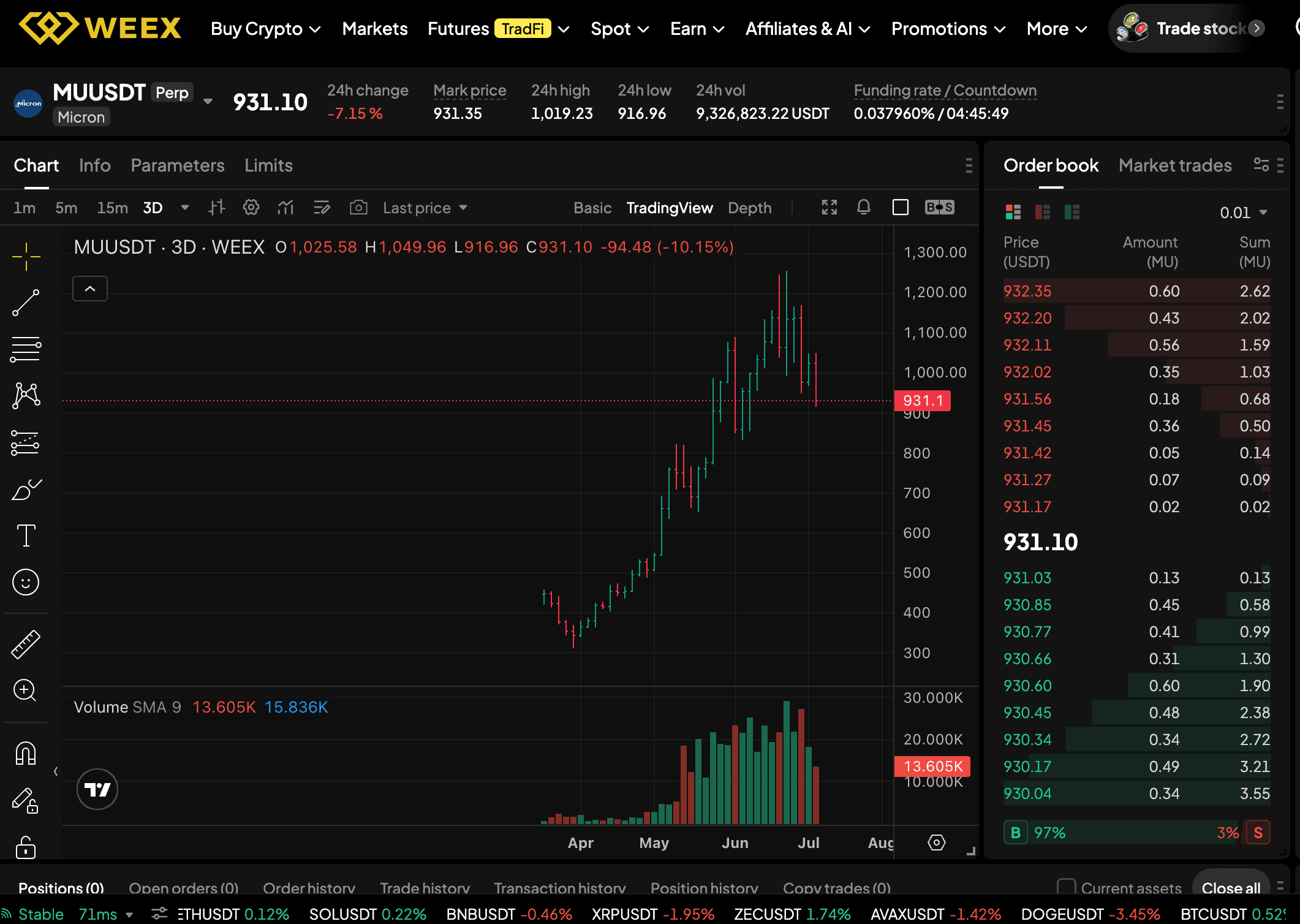
- MUUSDT is under pressure: The WEEX chart shows MUUSDT near $931.10, down about 7.15% over 24 hours.
- Recent high: The visible 24h high is around $1,019.23, showing how quickly the pullback developed.
- Possible reason: The decline looks like a mix of profit-taking, volatility after a strong run, and caution around memory-cycle expectations.
- Rebound trigger: A move back above $1,000 would improve the short-term technical picture.
- Risk signal: A break below $900 would make the pullback harder to dismiss as normal volatility.
WEEX lists MU/USDT perpetual futures for users who want to trade Micron-linked price exposure. New users can create a WEEX account before reviewing product eligibility, fees, funding, leverage rules, and local requirements.
Why Is Micron Stock Down Today?
Micron-linked MUUSDT is down sharply on the WEEX chart, trading near $931.10 after falling about 7.15% over 24 hours. The chart also shows a recent high around $1,019.23 and a low near $916.96, which points to a fast pullback after a strong move higher.
The simplest explanation is profit-taking. MU has been tied to AI memory enthusiasm, and fast rallies often create crowded positioning. When traders lock in gains or reduce risk, a high-momentum semiconductor name can fall quickly even if the long-term thesis has not changed.
Is the MU Drop a Warning Sign or a Dip?
The answer depends on whether MU holds support. A pullback toward the $916-$900 zone can be normal after a fast move. If buyers step in and MU reclaims $1,000, the decline may look like a reset. If the price breaks below $900, traders may treat it as a deeper risk-off signal.
- Healthy dip: MU holds $900 and starts rebuilding above $950.
- Neutral range: MU stays between $900 and $1,000 while traders wait for a catalyst.
- Bearish shift: MU loses $900 and momentum traders step away.
AI Memory Demand Still Matters
The long-term Micron story still revolves around memory demand. AI servers need large amounts of high-performance memory, and high-bandwidth memory has become an important part of the AI hardware stack. This is why MU can remain interesting even after a sharp pullback.
However, investors should not confuse a strong narrative with a straight-line chart. Memory stocks can be volatile because pricing, inventory, and capex expectations move in cycles. That makes MU more sensitive to sentiment shifts than many defensive stocks.
What Traders Should Watch Next
- $900 support: A key level for deciding whether the pullback is controlled or worsening.
- $1,000 recovery level: A reclaim would show stronger buyer confidence.
- Volume: The chart shows high activity, so follow whether selling volume fades or accelerates.
- Funding and leverage: Futures traders should watch funding costs and avoid overleveraged entries.
- Semiconductor sentiment: MU can move with broader AI chip and memory-stock risk appetite.
Bottom Line
Micron is down today because the market is digesting a sharp move, taking profits, and reassessing the near-term risk-reward. The pullback becomes more constructive if MU holds $900 and reclaims $1,000. It becomes more concerning if the price breaks below support with continued selling pressure.
Users interested in broader stock-linked markets can also review the WEEX TradeFi market and eligible campaign details on the WEEX U.S. stock contract promotion.
Before you go, you can learn about the WEEX Token (WXT) for ecosystem participation, and new users may explore the WEEX welcome bonus with limited-time rewards such as trading coupons and task-based incentives.
FAQ
Why is MU stock down today?
The visible MUUSDT move looks like profit-taking and short-term risk reduction after a strong AI memory rally.
Is Micron still an AI stock?
Micron is not an AI chip designer, but it is connected to AI infrastructure through DRAM, NAND, and HBM demand.
What level should MU traders watch?
The key support zone is around $916-$900, while $1,000 is the first major recovery level.
Disclaimer: This content is provided for general informational and educational purposes only and should not be considered financial, investment, legal, or tax advice. Nothing in this article constitutes an offer, recommendation, solicitation, or invitation to buy, sell, or trade any crypto asset or use any specific service. Crypto assets are highly volatile and involve a high degree of risk. You may lose some or all of the value of your investment and should not invest funds you cannot afford to lose.WEEX services may not be available in all regions and are subject to applicable laws, regulations, and user eligibility requirements. Please carefully assess risks and confirm local requirements before making any financial decisions.
You may also like

SHA-256 vs Other Hashing Algorithms: What’s the Difference
This guide breaks down sha-256 alongside SHA-1, SHA-3, and MD5 in clear terms: what each hash does, where…
What Is SHA-256? How This Hashing Algorithm Works
SHA-256 is a cryptographic hashing algorithm that turns any input—short or long—into a fixed 256-bit output. Think of…
Leverage Trading Risks Every Beginner Should Know
Leverage can amplify gains and losses in crypto derivatives. This guide breaks down why leverage trading carries extra…
How to Calculate Leverage and Position Size?
Leverage lets you control a larger position with smaller capital. This guide shows how to calculate leverage and…
What Is Leverage in Trading? A Complete Guide
Leverage lets you control a larger position with a smaller amount of capital, but it also raises the…
What Is Initial Margin vs Maintenance Margin
Margin trading lets you control a larger crypto position with less capital, but it also introduces liquidation risk.…
What Is a Limit Order? A Beginner’s Guide
A limit order lets you set your own price. Your trade only executes if the market reaches that…
When Market Orders Can Cost You More Than Expected
A market order is simple: you click buy or sell, and the trade executes at the best available…
Market Order vs Limit Order: Which Should You Use
Choosing between a market order and a limit order comes down to one trade-off: speed versus price. This…
What Is a Market Order? A Beginner’s Guide
A market order is the simplest way to buy or sell: you tell the exchange to execute immediately…
Is SHA-256 Still Secure in 2026?
Updated: 2026-07-08 SHA-256 underpins Bitcoin mining, block integrity, and countless wallets and exchanges. This article explains whether SHA-256…
How SHA-256 Secures the Bitcoin Blockchain
SHA-256 is the cryptographic hash function that powers Bitcoin’s proof-of-work and the chain of blocks. This article explains…
What Happens When You Get Liquidated on Leveraged Trades?
Leverage lets you control a large position with a small margin, but it also narrows the price move…
How Margin Calls Work and How to Avoid Them
Margin trading lets you borrow against your collateral to amplify exposure, but it also introduces the risk of…
Margin Trading vs Spot Trading: What’s the Difference
Margin trading lets you borrow funds to amplify exposure, while spot trading uses only your own capital to…
What Is Margin Trading? A Beginner’s Guide
Margin trading lets you use your own funds as collateral to borrow extra capital, so you can take…
What is The White Bull (LEVI) Coin? Everything You Need to Know Before Trading LEVI/USDT
This article explains what The White Bull (LEVI) is, why it’s drawing attention on Solana, and how LEVI/USDT…
Should You Store Large Crypto Holdings in a Cold or Hot Wallet
Choosing between a cold wallet and a hot wallet is not just a preference—large crypto holders face a…
SHA-256 vs Other Hashing Algorithms: What’s the Difference
This guide breaks down sha-256 alongside SHA-1, SHA-3, and MD5 in clear terms: what each hash does, where…
What Is SHA-256? How This Hashing Algorithm Works
SHA-256 is a cryptographic hashing algorithm that turns any input—short or long—into a fixed 256-bit output. Think of…
Leverage Trading Risks Every Beginner Should Know
Leverage can amplify gains and losses in crypto derivatives. This guide breaks down why leverage trading carries extra…
How to Calculate Leverage and Position Size?
Leverage lets you control a larger position with smaller capital. This guide shows how to calculate leverage and…
What Is Leverage in Trading? A Complete Guide
Leverage lets you control a larger position with a smaller amount of capital, but it also raises the…
What Is Initial Margin vs Maintenance Margin
Margin trading lets you control a larger crypto position with less capital, but it also introduces liquidation risk.…