
Cardano (ADA) Crash Analysis: Causes of the November Slump

 Prefer us on Google


Key Takeaways
- Cardano was split by a governance issue and a faulty AI transaction, not a classic hack.
- Panic selling by large investors led to a 16% ADA price drop; technically, ADA is now oversold.
- Opportunities for recovery include ETF news, technical upgrades, and more DeFi liquidity – risks remain.
Introduction
Cardano lost over 16 percent of its value in a few days in November 2025 – but what exactly happened? An AI-generated delegation transaction split the Cardano network into two parallel blockchains, revealing massive vulnerabilities in the decentralized governance system.
In this in-depth analysis, we explain the technical background of the network crash, why professional investors sold heavily, and what concrete opportunities are now emerging for investors.
The Network Crash: Chain Split via Faulty Transaction
On November 23, 2025, Cardano experienced an unprecedented network outage. A user named Homer J., an ADA staking pool operator, used AI-generated terminal commands to create a delegation transaction.
While this transaction was technically valid at the protocol level, it exploited an old security vulnerability in the Cardano software library. The result was devastating: older node versions (validator computers in the network) rejected the transaction, while newer versions processed it.
This led to the network splitting into two parallel blockchains – a "poisoned" chain and a "healthy" one. Block producers began working on separate branches, creating inconsistent data.
Major exchanges like Binance immediately halted deposits and withdrawals as a protective measure to safeguard their users. Analysts on CoinDesk reported on the incident within minutes, leading to massive panic selling.
Who was Homer J. and what were his motives?
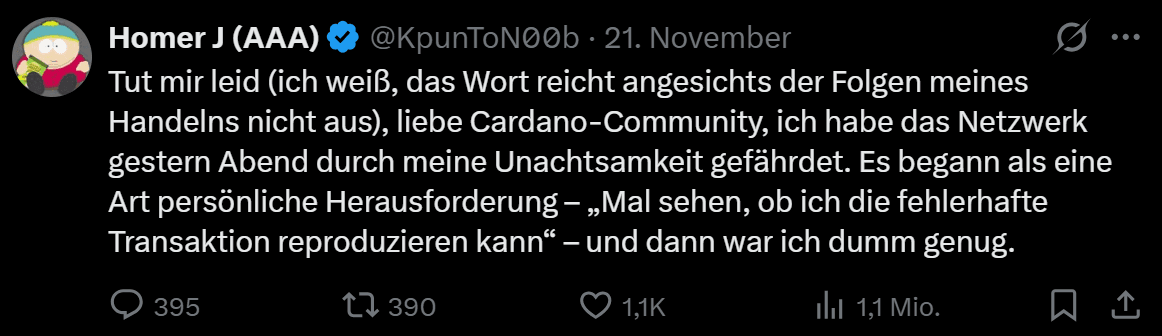
Homer J. later stated that he did not act maliciously, but only wanted to replicate the faulty transaction to test network vulnerabilities. He used AI-generated commands to block external traffic sources while conducting his experiments.
Only when block explorers went offline and pool rewards stopped did he realize the full extent of the disruption.
"I am ashamed of my carelessness," wrote Homer J. on social media. "I had no bad intentions, but I put the entire network at risk."
Source: X (Twitter)
Charles Hoskinson, co-founder of Cardano, however, described the event as a "targeted attack" and suggested potential criminal intent behind it. The FBI was subsequently involved, and the debate within the community over whether it was negligent behavior or a targeted attack continues to divide the community to this day.
The Technical Causes: Governance Failure in a Decentralized System
The incident reveals a fundamental problem with Cardano: decentralized network updates are slow, error-prone, and poorly coordinated. When newer software versions are incompatible with older ones without a strictly coordinated upgrade, exactly these kinds of chain splits occur.
Cardano is based on the Ouroboros Proof-of-Stake consensus mechanism, a theoretically very robust protocol. However, the governance structures – who can change code, how quickly patches can be rolled out, and how the community is involved – were not sufficiently tested for critical scenarios.
The Intersect governance group, Cardano's technical steering body, took several hours to develop a fix and communicate it to all pool operators. For established blockchains like Bitcoin or Ethereum, such a problem could have been escalated and resolved faster because the processes and communication channels are already proven.
Cardano reveals an uncomfortable truth here: decentralization comes with significant coordination costs.
The Price Crash: 16 Percent in Less Than 24 Hours
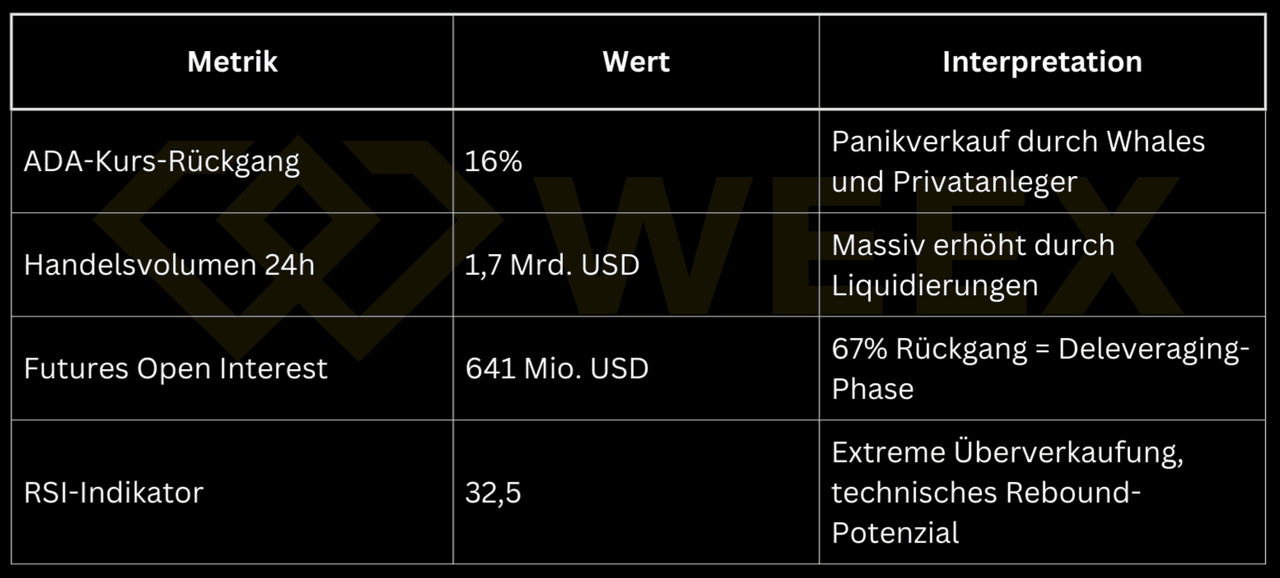
The ADA price reacted violently and immediately to the network instability. From 0.52 USD, ADA fell to 0.42 USD – a decline of over 16 percent in less than a day.
According to Yahoo Finance, three factors drove the crash:
- Fear of technical failure: Traders and institutional investors feared that the network might not be recoverable or that further critical security vulnerabilities existed.
- Large sales by whales: On-chain analyses show that large investors sold about 50 million ADA, triggering chain liquidations in futures markets.
- Macroeconomic factors: The entire crypto market suffered from weak sentiment and macroeconomic uncertainty; altcoins like ADA lost disproportionately.
The 24-hour trading volume jumped to 1.7 billion USD, while open interest in futures markets fell from 1.95 billion USD to just 641 million USD. Technical indicators showed massively oversold conditions: the Relative Strength Index (RSI) was at 32.5 – significantly below the 30 mark, which indicates extreme oversold status.
Consequences: Liquidity Crisis in the DeFi Ecosystem
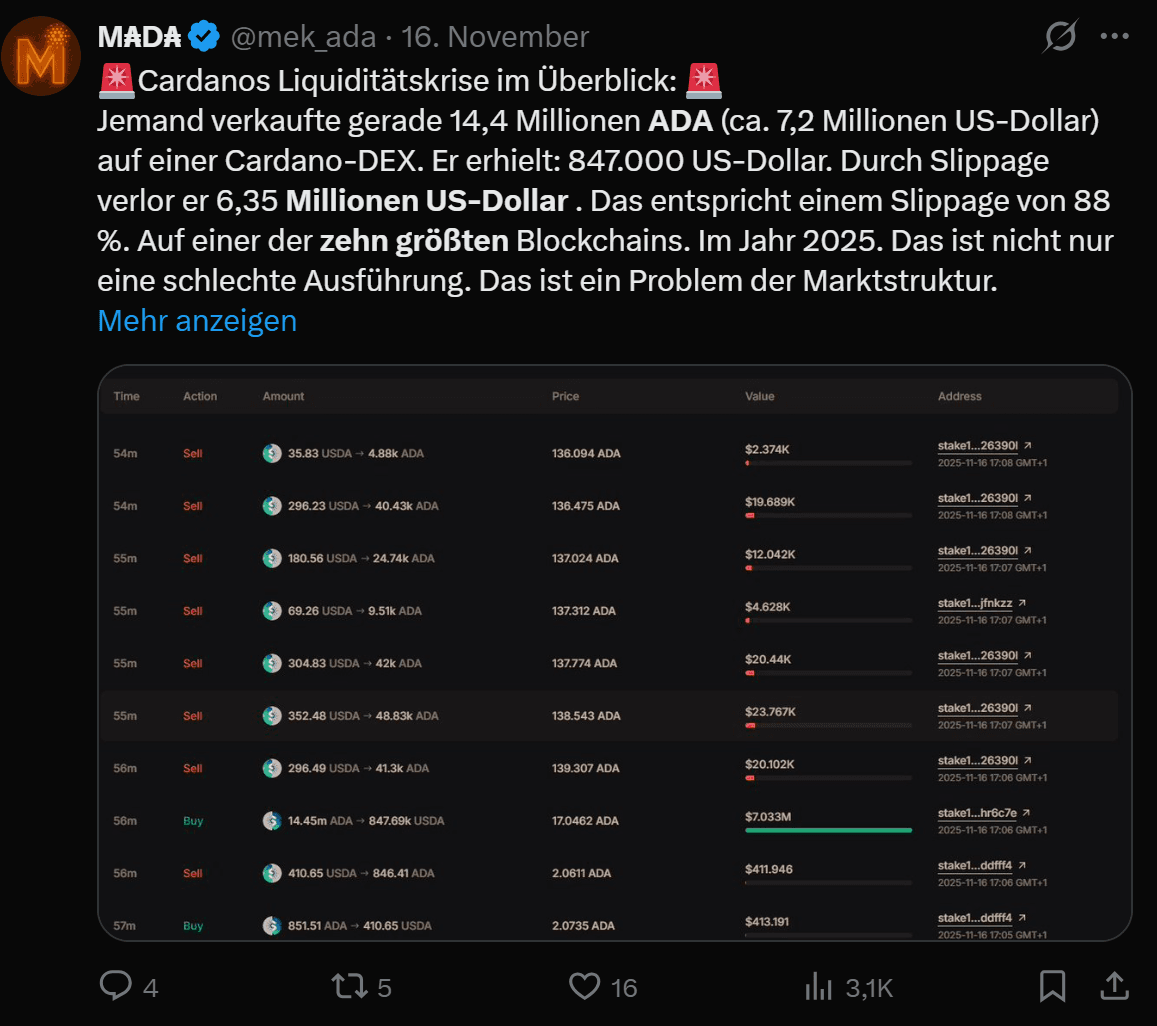
A particularly shocking detail came to light days later: a large decentralized finance trader attempted to swap 10 million ADA for the USDA stablecoin. Due to the extremely low liquidity in the automated liquidity pool, the slippage (price slide during the transaction) exploded, and the trader lost over 6 million dollars.
This event shows a critical problem: Cardano's DeFi ecosystem is underdeveloped and fragile. With only 233 million dollars in Total Value Locked – compared to over 60 billion USD for Ethereum – Cardano is still a dwarf in the DeFi space.
Stablecoin presence in the network is particularly critical: only 38 million dollars in stablecoins in a global industry with over 300 billion dollars in volume. This severely limits organic growth and does not attract risk-averse institutional investors.
According to the Cardano Foundation, new partnerships with established DeFi protocols are under negotiation to close this liquidity gap.
Source: X(Twitter)
What Happens Now? Current Roadmap and Recovery Strategy
The Cardano team acted quickly and decisively: Hotfix 1.1.5 was developed within 6 hours, and pool operators were instructed to upgrade to the new node version. After approximately 6 hours, the network was fully unified again, and all nodes were running on a single chain.
Charles Hoskinson announced several concrete measures:
- Stronger governance processes: Faster voting on critical bugs; Intersect will be equipped with additional resources to make decisions in minutes instead of hours.
- Automated monitoring systems: Detection of anomalous transactions before deployment to the mainnet; machine learning tools for early detection of protocol incompatibilities.
- Accelerated upgrades: The Ouroboros Phalanx upgrade and Leios scaling solutions are to be implemented faster.
Technical Analysis: Opportunities for a Counter-Movement
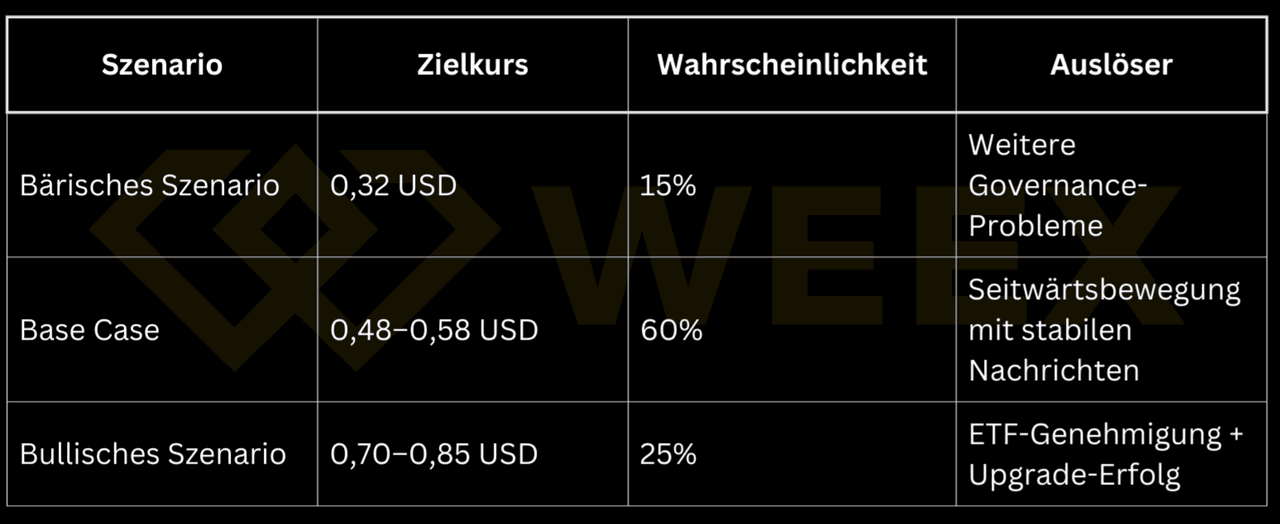
From a chart technical perspective, ADA is in an interesting setup: the RSI is at an extreme 32.5 – this suggests a counter-movement, as such extremes usually lead to rebounds. Technical support is at 0.48 USD; should ADA hold this mark, a rebound to 0.60 USD or even 0.70 USD could follow.
According to CoinMarketCap analysts, the next resistance level is at 0.58 USD (previous support level). A break above 0.60 USD would signal a bullish trend for the coming weeks.
Buy ADA on WEEX now and profit from the price drop!
Medium-Term Catalysts for Price Stabilization
Three concrete events could stabilize and boost the Cardano price in the coming months:
- SEC approval for a Cardano ETF: If the US Securities and Exchange Commission (SEC) approves a Cardano ETF, this could lead to massive institutional inflows and generate stabilizing buying pressure – similar to Ethereum after its ETF approval in 2024.
- Successful technical upgrades and governance reforms: If Cardano proves that it can react faster, more coordinately, and more robustly to critical problems, this would regain the community's trust.
- Recovery and growth of the DeFi ecosystem: New partnerships with established stablecoin providers, improved liquidity, and new smart contract platforms could increase the DeFi TVL from the current 233 million to over 5 billion dollars.
Experts on CoinDesk expect price ranges between 0.36–0.70 USD for the remaining months of 2025.
Conclusion: Cardano at a Turning Point
The November crash was not just a market slump – it was a fundamental failure of governance and the decentralized update process. Cardano must now prove that it can react faster, more coordinately, and more robustly to critical problems.
The good news: no user funds were lost in the crash, the network was quickly restored, and the community mobilized promptly. The central question remains: will Cardano learn from this incident and build a better, more secure network – or will the trust be irreparably damaged?
For speculatively oriented investors with a higher risk tolerance, ADA currently offers attractive technical entry points with chances for 30–50% profit if the catalysts take hold. Conservative investors, however, should wait for concrete governance improvements and ETF news before investing again.
FAQ - Frequently Asked Questions
What exactly happened with Cardano on November 23?
What happened with Cardano on November 23: A faulty AI transaction split the network because older and newer versions reacted differently. After 6 hours, a hotfix resolved the issue.
Did users lose money or were coins stolen?
No user capital was lost or stolen. Losses only occurred due to the price drop and liquidations, not due to security issues.
Is Cardano now insecure after this incident?
The security of the blockchain remained intact. The problem lay in governance and software coordination, not in cryptography.
When will the ADA price go back to 0.52 USD or higher?
The ADA price could partially recover in 4–8 weeks; a full recovery to 0.60+ USD is possible with positive news or upgrades in 2–3 months.
Should I buy or sell ADA now?
Whether buying now makes sense depends on your risk tolerance: ADA is technically oversold and could rise in the short term; medium-term profits of 30–50% are possible – waiting is recommended if you are uncertain.
WEEX | Rising Star of Crypto Exchanges in the DACH Region
WEEX combines security, innovation, and community with features for beginners and professionals:
Security & Protection
- 1,000 BTC Protection Fund: Self-funded reserve for rapid loss protection in exceptional cases
Trading & Earning
- Auto Earn: Daily automatic USDT earnings without effort
- Copy Trading: Follow elite traders automatically or apply as an elite trader for additional benefits
- WE-Launch: Early access to new projects – exclusive for WEEX users
Benefits & Rewards
- Promotions & Rewards: Trading competitions and special bonuses for active users
- Affiliate Program: Lifetime commissions through new users – details here
- VIP Benefits: Lowest fees, market insights, and personal support for high-volume traders
- WXT Token: Fee discounts, airdrops, and exclusive platform benefits
Discover current trends on WEEX Spot and get started now: Register now
Disclaimer – Legal Notice from WEEX Exchange
WEEX and its affiliates offer services for the exchange of digital assets, including derivatives and margin trading, only where legal and for eligible users. All content is general information, not financial advice – seek independent advice before trading. Trading cryptocurrencies involves high risk and can lead to a total loss. By using WEEX services, you accept all associated risks and terms. Never invest more than you can afford to lose. Further information can be found in our Terms of Service and in the Risk Disclosure.
Disclaimer: This content is provided for general branding and informational purposes only and doesn't constitute financial, investment, legal, or tax advice. Any events, rewards, online events, or related information mentioned herein should not be considered a recommendation, solicitation, or invitation to purchase, sell, trade, or otherwise deal in any crypto assets or to use any services. Crypto assets are highly volatile and may result in loss. WEEX services and online events may not be available in all regions and are subject to applicable laws, regulations, and eligibility requirements. You are responsible for ensuring that your use of WEEX services complies with local laws and for carefully assessing the risks before participating in any crypto-related activities.
You may also like
USA Rare Earth Stock (USAR): Bull Case, Risks, and the 2028 Bet
USA Rare Earth stock (USAR) explained — what the company does, why shares slumped in 2026, the Round Top bull case, the MP Materials lawsuit, and key risks.
USAR Stock Price Prediction: Can USA Rare Earth Reclaim $40?
USAR stock price prediction: USA Rare Earth trades near $19 vs a $36–$39 analyst target. Bull case, bear case, and 2026–2030 scenarios.

Meta Stock in 2026: Price, Forecast, and How to Trade It
Meta stock near $630 in July 2026, down YTD on AI capex fears. See the price, analyst forecast, bull vs bear case, and how to trade META exposure.

Costco Stock (COST): Price, Forecast, and Is It a Buy in 2026
Costco stock (COST) trades near $915–950 in July 2026 at ~48x earnings. See the latest price, analyst forecast, dividend, and how to buy.
SK Hynix Stock: Inside the AI Memory Giant's Nasdaq Debut
SK Hynix stock lists on Nasdaq July 10 as SKHY in the biggest ADR debut ever. Price, 2026 forecast, HBM bull/bear case, and how to buy.
Risks of Shorting Bitcoin You Should Know Before You Trade
Shorting can look simple: you profit when price falls. But the bitcoin short is different from buying because…

Shorting Bitcoin vs Buying Put Options: What’s the Difference
This guide breaks down two ways to express a bearish view on BTC: opening a bitcoin short with…
Prismevm (PP) Airdrop on WEEX: How to Unlock New User Rewards
This guide explains what Prismevm (PP) is, how the Prismevm (PP) airdrop on WEEX works, and a simple,…
How to Short Bitcoin: Methods and Platforms Compared
A bitcoin short lets you profit if BTC falls. This guide explains how to short bitcoin using futures,…
What Is Dollar-Cost Averaging (DCA)? A Beginner’s Guide
Dollar-cost averaging (DCA) is a simple strategy: invest a fixed amount on a fixed schedule, no matter the…
What Does It Mean to Short Bitcoin? A Beginner’s Guide
Shorting is the opposite of buying. Instead of hoping Bitcoin goes up, you take a bitcoin short to…
How to Join GROVE Airdrop and Unlock 50,000 USDT Rewards
The GROVE airdrop marks Grove Finance’s token debut on WEEX with a clear, rules-based campaign that rewards deposits,…
What is Cash Cat (CASHCAT) Coin? Everything You Need to Know Before Trading CASHCAT/USDT
This article explains what Cash Cat (CASHCAT) is, how it works on Robinhood Chain, what drives demand, how…
Bitcoin Price Prediction 2026: Is the BTC Bottom Finally In?
This article maps a clear path to Bitcoin Price Prediction 2026 and weighs the question: Is the BTC…
Aptos (APT) Token Unlock July 12: Will APT Price Crash?
Aptos (APT) faces a scheduled token unlock on July 12, and traders are asking if the added supply…
What is Bitmine BMNR and Why Does It Own 5.7 Million ETH?
This article explains the claim that “Bitmine BMNR” controls 5.7 million ETH, what Bitmine BMNR might be, how…
Why is XRP Price Pumping Today After Ripple MiCA License Approval?
XRP price momentum accelerated after reports that Ripple secured a MiCA-compliant authorization in the EU, a milestone that…
Why Did Bitcoin Drop 33% While Semiconductor Stocks Pumped 102%?
Bitcoin’s 33% drawdown alongside a 102% surge in semiconductor stocks looks contradictory, but the gap is explainable. This…

Is Bitmine Immersion Technologies Safe? BMNR Crypto Holdings Explained
This guide breaks down what Bitmine BMNR and BMNR Crypto could represent, how to judge safety for Bitmine…
Why is Bitcoin Crashing Below 64K After the Weekend Rally?
Bitcoin’s slide below 64K after a strong weekend bounce looks jarring, but the mechanics are familiar: thin weekend…
Crypto Kidnapping and Torture Case: 5 Crucial Rules to Protect Your Cold Wallet Private Keys
Crypto kidnapping is a blunt, offline attack that targets you—not your code. This guide explains how kidnappers force…
What is Trump Crypto Coin and Why Did It Lose 3.8 Billion Dollars?
This article explains what people mean by “Trump Crypto” coin, why multiple Trump-themed tokens surged and then rapidly…
What is Ripple MiCA Crypto Authorization and How Does It Work?
Ripple MiCA Crypto Authorization refers to the process a Ripple-affiliated entity would follow to operate legally under the…
Is Trump Crypto Coin a Scam? The $3.8 Billion Loss Report Explained
“Trump Crypto” has become a catch-all label for tokens, NFTs, and memecoins that reference the former U.S. president.…

What is the Patrick Witt Crypto Bill? US Strategic Bitcoin Reserve Explained
This article explains what people mean by the “Patrick Witt Crypto Bill,” why a U.S. Strategic Bitcoin Reserve…

What Is CASHCAT Crypto and Why Did It Pump 950% Today?
What is CASHCAT crypto? Robinhood Chain memecoin surged 950% on July 8 after CEO's tweet. One trader turned $838 into $1M. Full analysis, risks, and what to know. (156 characters)
Alibaba Stock in 2026: Price, Forecast, and How to Trade BABA
Alibaba stock trades near $109 in mid-2026 with analyst targets around $190. Here's the BABA outlook, the real risks, and how to trade it with USDT.
NVIDIA Stock in 2026: Price, Forecast, and How to Trade It
NVIDIA stock hit ~$204 in July 2026 with a forward P/E near a 6-year low. See what's driving NVDA, the bull vs bear case, and how to trade it on WEEX.
SNDK Stock: Why SanDisk Soared and How to Trade It
SNDK stock is up ~892% in 2026 on the AI-storage boom. See the price today, analyst forecasts, split odds, and how to trade SNDK on WEEX.
SNDK Stock: SanDisk's AI Memory Surge and 2026 Outlook
SNDK stock is up ~635% in 2026 on the AI memory boom. See SanDisk's price, earnings, analyst forecast, risks, and how to get exposure.
USA Rare Earth Stock (USAR): Bull Case, Risks, and the 2028 Bet
USA Rare Earth stock (USAR) explained — what the company does, why shares slumped in 2026, the Round Top bull case, the MP Materials lawsuit, and key risks.
USAR Stock Price Prediction: Can USA Rare Earth Reclaim $40?
USAR stock price prediction: USA Rare Earth trades near $19 vs a $36–$39 analyst target. Bull case, bear case, and 2026–2030 scenarios.
Meta Stock in 2026: Price, Forecast, and How to Trade It
Meta stock near $630 in July 2026, down YTD on AI capex fears. See the price, analyst forecast, bull vs bear case, and how to trade META exposure.
Costco Stock (COST): Price, Forecast, and Is It a Buy in 2026
Costco stock (COST) trades near $915–950 in July 2026 at ~48x earnings. See the latest price, analyst forecast, dividend, and how to buy.
SK Hynix Stock: Inside the AI Memory Giant's Nasdaq Debut
SK Hynix stock lists on Nasdaq July 10 as SKHY in the biggest ADR debut ever. Price, 2026 forecast, HBM bull/bear case, and how to buy.
Risks of Shorting Bitcoin You Should Know Before You Trade
Shorting can look simple: you profit when price falls. But the bitcoin short is different from buying because…