
Cardano (ADA) 2026: Is Cardano Finally Delivering in 2026? A Roadmap of Leios, Midnight, and Voltaire


Introduction: A Cognitive Reframing of Cardano in 2026
For years, Cardano was often described—sometimes unfairly—as a blockchain that lived more in research papers than in real markets. Critics called it “academic,” “slow,” or “over-engineered.”
By 2026, that perception is undergoing a profound cognitive reframing.
Cardano is increasingly being evaluated not as a speculative network chasing short-term hype, but as a long-term financial infrastructure platform built on formal verification, deterministic execution, and governance decentralization. The conversation has shifted from “Can Cardano ship?” to “Is Cardano becoming one of the most structurally resilient blockchain ecosystems?”
At the start of 2026, technical analysts also pointed to a symbolic market signal: ADA formed a golden cross on higher-timeframe charts, reflecting renewed institutional interest and long-term accumulation trends. While technical indicators alone do not define fundamentals, they often mirror shifts in narrative and capital flows.
To understand whether Cardano has truly reached an inflection point, we must examine three pillars shaping Cardano 2026:
- Ouroboros Leios and the evolution of scalable consensus
- Midnight and the emergence of compliant privacy infrastructure
- Voltaire governance and the activation of a billion-dollar treasury
Together, these developments suggest that Cardano may finally be transitioning from theory to global-scale execution.
The Technical Breakthrough: Understanding Ouroboros Leios
Beyond TPS: A Structural Shift in Blockchain Architecture
Many discussions about scaling focus narrowly on transactions per second. Ouroboros Leios represents something deeper: a rethinking of how blockchains process, validate, and include transactions.
Instead of treating block production as a single linear pipeline, Leios introduces mechanisms that enable parallel block processing and decoupled transaction inclusion.
This architecture allows the network to scale without sacrificing determinism or security guarantees—two properties essential for institutional adoption.
Parallel Block Processing Explained
Traditional blockchains process transactions sequentially within each block. This approach ensures consistency but limits throughput.
Leios introduces a layered system:
- Transaction data can be collected and pre-processed in parallel streams.
- Validation tasks are distributed across multiple participants.
- Final settlement integrates results into a unified ledger state.
This model reduces bottlenecks and improves network utilization. More importantly, it preserves predictable execution costs—something enterprises value far more than raw speed.
Decoupled Transaction Inclusion
A major innovation in Leios is the separation of responsibilities between:
- Transaction collectors
- Validators
- Block producers
By decoupling these roles, the system avoids congestion at a single coordination point. Transactions can be propagated and validated independently before final inclusion, increasing resilience and throughput simultaneously.
This approach also aligns with principles outlined in emerging Cardano standards such as CIP-164, which formalize transaction metadata structures and composability under high-throughput conditions.
Robust Optimistic Scaling
Leios introduces what researchers describe as robust optimism.
Optimistic execution assumes that most transactions are valid and processes them quickly, while maintaining a provable rollback path if conflicts occur. Unlike purely optimistic rollups, this model integrates rollback and verification mechanisms directly into the protocol layer.
The result is a hybrid scaling strategy that combines performance gains with mathematically provable safety.
Supporting coordination mechanisms, sometimes referred to in research discussions as the Kachina protocol, help maintain causal consistency across parallel processing channels, ensuring deterministic outcomes even under heavy load.
The Privacy Narrative: Midnight and Rational Privacy
Why Privacy Matters in Institutional Finance
Public blockchains have historically struggled to attract large enterprises because of transparency concerns. Corporations cannot expose transaction details, supplier relationships, or internal financial flows on a fully public ledger.
The Midnight partner chain addresses this issue through a concept often described as rational privacy.
Rather than offering absolute anonymity, Midnight focuses on selective disclosure and compliance-ready confidentiality.
Intelligent Compliance Through Zero-Knowledge Technology
Midnight integrates zero-knowledge proofs to allow transactions to be validated without revealing sensitive information.
At the same time, the system supports controlled audit capabilities, enabling regulators or counterparties to verify compliance when legally required.
This concept—sometimes called intelligent compliance—is increasingly important as financial institutions seek blockchain solutions that meet regulatory standards.
Why Enterprises Are Paying Attention
Cloud providers and traditional financial institutions are particularly interested in infrastructure that combines:
- Data confidentiality
- Verifiable compliance
- Operational transparency
Technologies like Midnight create a bridge between decentralized systems and enterprise requirements, making blockchain integration more practical in sectors such as banking, healthcare, and supply-chain finance.
The associated ecosystem token, Midnight NIGHT, is expected to play a role in governance, privacy-service payments, and network incentives, reinforcing connections between the privacy layer and the broader Cardano economy.
Governance Power: Voltaire and the Billion-Dollar Treasury
A Treasury Large Enough to Shape an Ecosystem
One of Cardano’s most distinctive features in 2026 is its on-chain treasury, estimated to hold the equivalent of over $1 billion in funding capacity.
This treasury is not controlled by a foundation or private entity. Instead, it is governed through community voting mechanisms.
How DReps Work
Under the Voltaire governance model:
- ADA holders delegate voting power to Delegated Representatives (DReps).
- DReps review funding proposals and policy changes.
- Approved initiatives receive treasury funding through transparent, on-chain processes.
This structure reduces reliance on centralized decision-making and eliminates single-point governance risks that have affected other blockchain ecosystems.
Why Governance Matters for Long-Term Value
Governance is often underestimated in blockchain valuation. Yet infrastructure platforms succeed or fail based on their ability to allocate resources effectively over time.
A decentralized treasury allows Cardano to fund:
- Developer tooling
- Research initiatives
- Ecosystem grants
- Infrastructure improvements
This creates a self-sustaining innovation cycle independent of venture capital cycles.
The Competitive Landscape: Cardano vs Ethereum vs Solana
In the multi-chain world of 2026, competition has matured. The question is no longer which blockchain is fastest, but which architecture best supports real-world, large-scale applications.
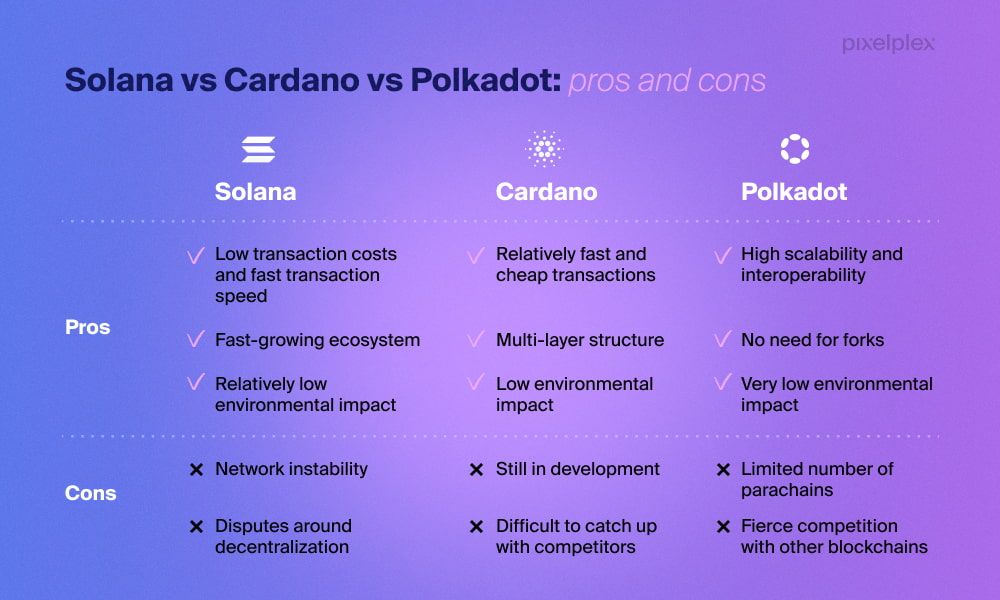
Cardano vs Solana: Speed vs Deterministic Security
Solana, particularly after the Firedancer client improvements, achieves extremely high throughput and low latency. This makes it ideal for high-frequency trading, gaming, and consumer-facing applications.
Cardano’s design philosophy prioritizes:
- Deterministic fees
- Formal verification
- Predictable execution
These qualities make it attractive for government systems, financial infrastructure, and regulated industries where reliability outweighs raw speed.
Cardano vs Ethereum: Integration vs Modularity
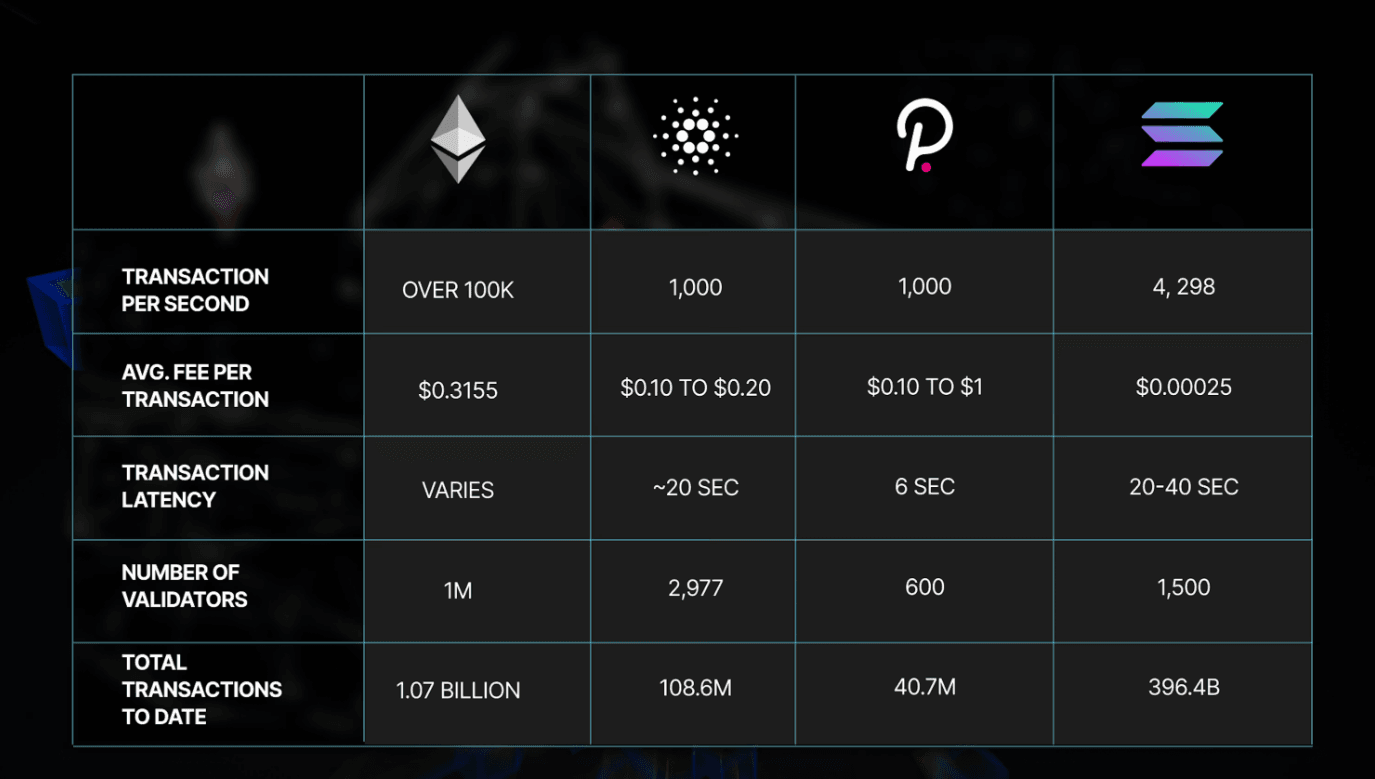
Ethereum continues to dominate in developer activity and ecosystem size, supported by Layer-2 scaling solutions and upgrades such as Pectra.
However, Ethereum’s modular architecture introduces complexity:
- Liquidity fragmentation across rollups
- Cross-chain bridging risks
- Increased user-experience friction
Cardano’s layered yet integrated design—combined with the eUTxO model—offers a different trade-off: fewer moving parts at the base layer and more predictable execution behavior.
Ecosystem Expansion: From DApps to Real-World Assets
By 2026, the Cardano ecosystem has expanded far beyond early experimental applications.
DeFi and Stablecoins
The introduction of regulated stablecoins such as USDA and USDM has strengthened lending, liquidity provision, and payment use cases.
Protocols including Minswap, Indigo, and Aada Finance have contributed significantly to total value locked, while cross-chain interoperability solutions are enabling broader asset flows.
Digital Identity and NFTs
NFTs on Cardano are evolving beyond collectibles into functional assets. Identity frameworks like Atala PRISM are being integrated into education and credentialing systems, enabling verifiable records stored on blockchain infrastructure.
Real-World Assets and Supply Chains
Tokenization of physical assets—particularly in luxury goods, agriculture, and pharmaceuticals—has become a major area of growth. Blockchain-anchored provenance systems improve transparency while reducing fraud risks.
Investment Outlook: ADA Price Prediction and Market Structure
The Impact of Staking
With an estimated staking ratio near 60%, Cardano maintains one of the highest staking participation rates among major blockchains.
High staking participation reduces circulating supply and strengthens network security, both of which influence long-term valuation dynamics.
ADA Price Prediction for 2026
Based on network growth, staking dynamics, and macro conditions, analysts often discuss a potential ADA price prediction range between $1.20 and $1.85 under moderate adoption scenarios.
This range is not a guarantee, but reflects assumptions about:
- Treasury-funded ecosystem growth
- Midnight adoption
- Increased institutional participation
The Role of NIGHT in the Ecosystem
The Midnight NIGHT token could play a significant role in privacy infrastructure markets. As demand for compliant privacy grows, NIGHT-driven services may indirectly increase demand for ADA through settlement and staking mechanisms.
Risks and Challenges
Despite progress, several risks remain:
- Slower ecosystem growth compared to competitors
- Fewer breakout consumer applications
- Complexity of Haskell-based development environments
- Evolving global regulatory attitudes toward privacy technology
Recognizing these risks is essential for balanced analysis.
FAQ
Is Cardano still developing too slowly?
Cardano’s development pace reflects its research-driven approach. While slower than some competitors, this method reduces the likelihood of critical security failures and network instability.
Can Leios realistically compete with high-performance chains?
Leios is not designed to beat every chain in raw TPS. Its goal is to provide scalable performance while maintaining deterministic execution and formal security guarantees.
Will Midnight face regulatory pushback?
Privacy technologies always face scrutiny, but Midnight’s compliance-oriented design aims to mitigate regulatory concerns through selective disclosure and auditability.
Does governance really matter for investors?
Yes. Governance determines how ecosystems allocate capital and adapt to market conditions. A functioning treasury and voting system can significantly influence long-term sustainability.
Conclusion: The Academic Approach Comes Full Circle
Cardano’s journey demonstrates that research-driven development can be a competitive advantage rather than a liability.
By 2026, the combination of Ouroboros Leios, Midnight, and Voltaire governance suggests that Cardano is no longer merely an academic experiment. It is increasingly positioned as a credible infrastructure layer for global finance.
The real question now is not whether Cardano can deliver—but how far its model of mathematically grounded, governance-driven blockchain infrastructure can scale in a rapidly evolving digital economy.