
Shorting MSTR to Make 100% Profit: How Did He Approach This Trade?


Original Title: How Jim Chanos outplayed Michael Saylor: short MSTR, long BTC
Original Author: Proto Staff
Translation: Peggy, BlockBeats
Editor's Note: When the Strategy of using a company as a vehicle to hold Bitcoin became a belief, Jim Chanos chose to bet in the opposite direction: short MSTR, long BTC.
Seemingly divergent, yet fundamentally similar: both sides are exploiting market structural biases, one through belief with leverage, the other through rational dismantling of the bubble. In this contest of valuation and liquidity, faith and doubt are not distinctly separated, but two choices reflecting each other.
The following is the original text:

Wall Street's renowned "Mungerite" investor Jim Chanos has closed out his much-discussed and controversial short trade against Michael Saylor's Strategy - speculated to have yielded around a 100% return by shorting the company's common stock, MSTR.
More precisely, this famous short seller established a paired trade: shorting MSTR while simultaneously longing Bitcoin (BTC).
He was not betting that MSTR's stock price would absolutely fall in USD terms, but rather that the premium of MSTR relative to BTC would narrow.
Strategy is one of the world's largest Digital Asset Treasury (DAT) companies, where such publicly listed firms acquire crypto assets using financial leverage rather than relying on traditional product or service sales for revenue generation. The company currently holds approximately $66 billion worth of Bitcoin (BTC), with an enterprise value of around $840 million (market value plus indicative net debt including preferred shares), translating to a 1.27x premium to its modified net asset value (mNAV).
However, since Chanos established his position, this mNAV has significantly declined.
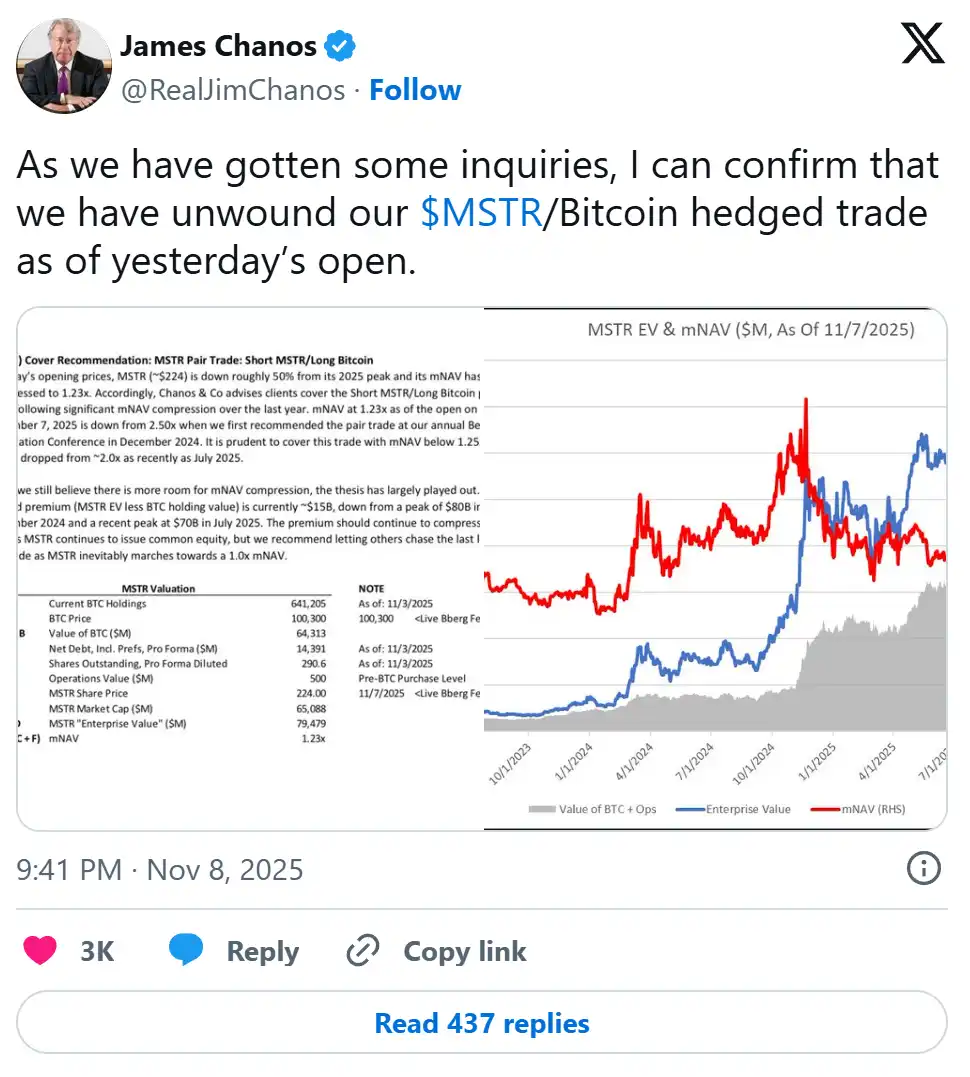
He initiated this dual-leg trade in November 2024 to express skepticism about the performance of MSTR compared to Bitcoin; as of early last Friday morning, Chanos and his company Chanos & Co. have closed out all positions, with a realized gain of around 100%.
Chanos' "Victory Parade" shared on social media has sparked discussion, and the related post has now been viewed over 1 million times.
Shorting MSTR, Longing BTC
Chanos' gains mainly came from the decline in MicroStrategy's Net Asset Value Multiple (mNAV).
By November 2024, this multiple had once been above 3 times; by the time he outlined his investment thesis at the annual conference in the same year, the average level had dropped to around 2.5 times. When he completely exited the position, MSTR's mNAV had fallen to 1.23 times—meaning the company's stock price was only 23% higher than the premium on its held Bitcoin assets.
At the same time, another part of his trade was also on the rise. Since November 2024, the Bitcoin price has risen by approximately 25%. In other words, Chanos not only doubled his funds by shorting MSTR but also earned about 25% in gains due to Bitcoin's appreciation.
Profiting on both sides, this family office fund manager solidified his position as the "Most Successful Saylor Critic."
Imitation Strategy, Outperforming Strategy
Chanos immediately faced fierce criticism from Saylor supporters, including community members self-proclaimed as "Irresponsibly Long MSTR," after publicly expressing his bearish view on Strategy at the 2025 New York Sohn Investment Conference.
In numerous TV interviews and social media appearances, Chanos emphasized that his bearish view stemmed from Strategy's difficulty in maintaining a high mNAV over the long term.
He described his trading strategy as: "Sell MicroStrategy's stock, buy Bitcoin—essentially buying something for $1 and selling it for $2.5." He also bluntly criticized Saylor's leverage-based Bitcoin purchases as "extremely absurd" and "pure financial gibberish."
In fact, Chanos believes that his trading logic fundamentally imitates Saylor himself: selling MSTR to buy Bitcoin with the proceeds.
Chanos has repeatedly pointed out that Strategy's continuous dilution of its own shares and ongoing sale of MSTR were key motivators for him to establish this pair trade (short MSTR, long BTC).
While Strategy has also raised billions of dollars through preferred stock financing (which does not directly dilute MSTR’s shares for now), most of its funding still comes from selling MSTR shares.
You may also like

Morning News | CME Group launches Nasdaq Cryptocurrency Index futures; Asset management giant Janus Henderson strategically invests in Ethena

Bitcoin Layer 2 Network Botanix: Why Did We Choose to Dissolve?

Why did Oracle deliver the strongest financial report in history, yet its stock price fell?
When the P2P illicit funds from ten years ago turned into 60,000 bitcoins

Dialogue with OmenX Founder: Why does the prediction market need an evolution from "spot" to "derivatives"?
Galaxy in-depth report: Is Solana still worth paying attention to?

Young people in South Korea make a "final effort" in the epic bull market

The pricing controversy of Trade.xyz exposes the fatal weakness of Pre-IPO perpetual contracts

How much longer can Ethereum's last big buyer hold on?

World Cup 2026 Coming – WEEX Celebrates with $1M Prize Pool & Michael Owen Live

Morning Report | OpenAI has submitted an S-1 registration statement draft to the U.S. SEC; Morpho completes $175 million financing

Galaxy Deep Research Report: How Hyperliquid's HIP-4 Upgrade Changes the Landscape of Prediction Markets?

Latest research from 13 top universities including Cornell University: The current state, challenges, and misconceptions of the fusion of Crypto and AI

Deconstructing Anthropic: The Best AI Company, Possibly Also a Type of Organizational Invention

Every exchange is a "Universal Exchange."

The counterattack of traditional finance: Alliance chains are quietly reviving
Pantera Capital Partner: How Tokenization is Restructuring the Private Equity and Early Investment Ecosystem?

Mastercard Launches Agent Pay for AI, Plans to Record AI Agent Payment Authorizations on Polygon
Mastercard launched Agent Pay for AI, a new payment protocol designed to help AI agents make small payments such as pay-per-use access to data and APIs. The system plans to record human-granted AI agent permissions on Polygon, focusing on verifiable authorization, identity, and payment controls.
Morning News | CME Group launches Nasdaq Cryptocurrency Index futures; Asset management giant Janus Henderson strategically invests in Ethena
Bitcoin Layer 2 Network Botanix: Why Did We Choose to Dissolve?
Why did Oracle deliver the strongest financial report in history, yet its stock price fell?
When the P2P illicit funds from ten years ago turned into 60,000 bitcoins
Dialogue with OmenX Founder: Why does the prediction market need an evolution from "spot" to "derivatives"?
Galaxy in-depth report: Is Solana still worth paying attention to?


