
After 3 years and millions of dollars spent, Uniswap has withstood the SEC investigation.



Original Article Title: "SEC Ends Uniswap Investigation! Founder: Spent 3 Years and Burned Millions, DeFi Finally Triumphs"
Original Article Author: BlockTempo of ChainNews
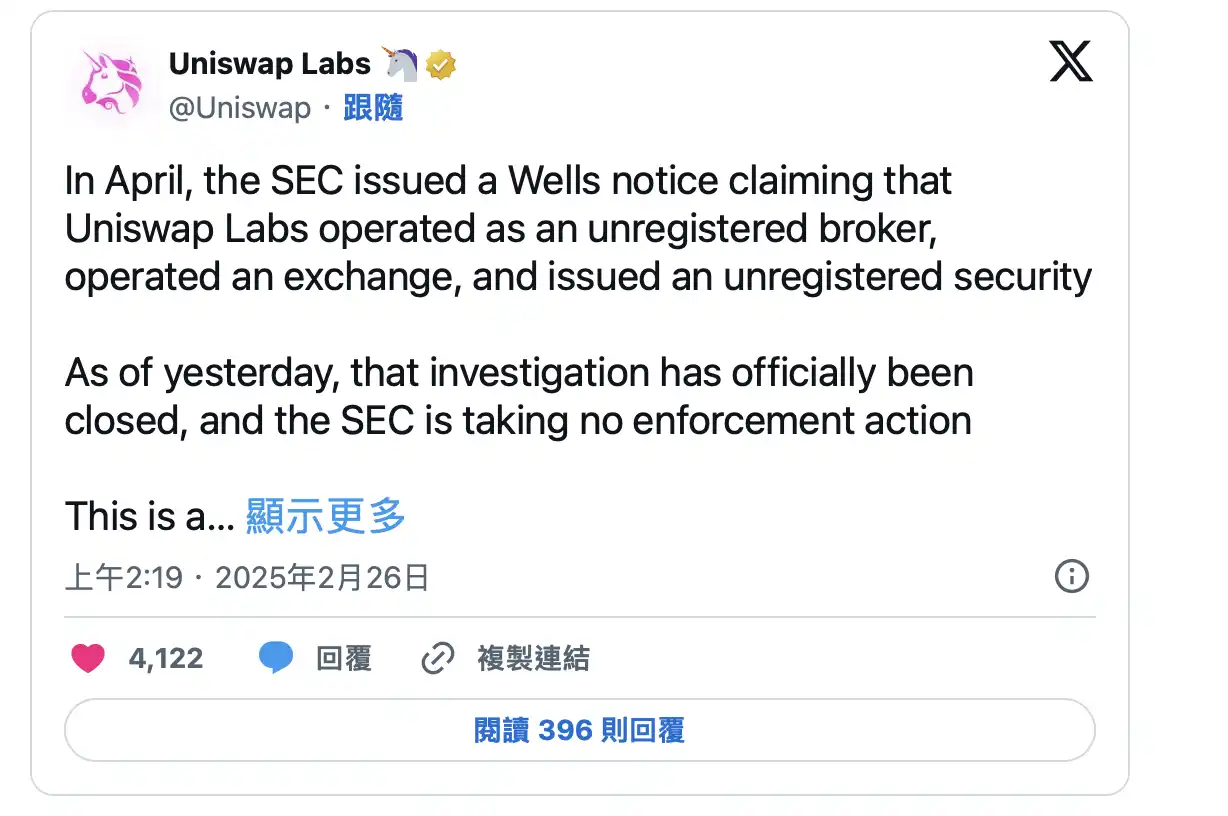
In April last year, the U.S. Securities and Exchange Commission (SEC) issued a Wells Notice to Ethereum decentralized exchange (DEX) leader Uniswap Labs, accusing it of operating an unregistered securities exchange, engaging in unregistered broker or clearing activities, and even involving unregistered securities issuance, potentially facing legal action.
Today, this saga has finally come to an end. Uniswap Labs announced early this morning (26th) that the SEC officially closed the investigation yesterday and did not take any enforcement action. The official statement described this as a "major victory for DeFi" and emphasized:
"This once again proves the fact we have always believed in—that the technology we are building is on the right side of the law, and our work is on the right side of history."
Uniswap: Decentralized Finance is the Future, and Now the U.S. Can Lead This Trend
Uniswap Labs further stated in the announcement that DeFi is improving the financial market, allowing users to trade instantly, securely, and transparently without relinquishing control of their assets.
At Uniswap Labs, we are committed to expanding the accessibility of DeFi through technology, enhancing liquidity and price transparency, reducing reliance on intermediaries, and lowering transaction costs. The products we are building not only serve users but also make the entire financial system more robust.
Uniswap also commended the SEC's new leadership, believing that they are reevaluating enforcement investigations and litigations within the industry, not limited to the Uniswap case, and recognizing that there are more effective ways to protect American consumers.
The conclusion of this investigation is not just a victory for Uniswap Labs, but also a collective victory for the DeFi community, developers, and users as we strive to build a better financial system.
Finally, Uniswap reiterates that they have always been willing to engage in dialogue with regulatory agencies and policymakers to establish a clear and reasonable DeFi regulatory framework, and look forward to engaging in more constructive discussions in the future.
Hayden Adams: SEC Investigation Cost Us 3 Years and Millions of Dollars
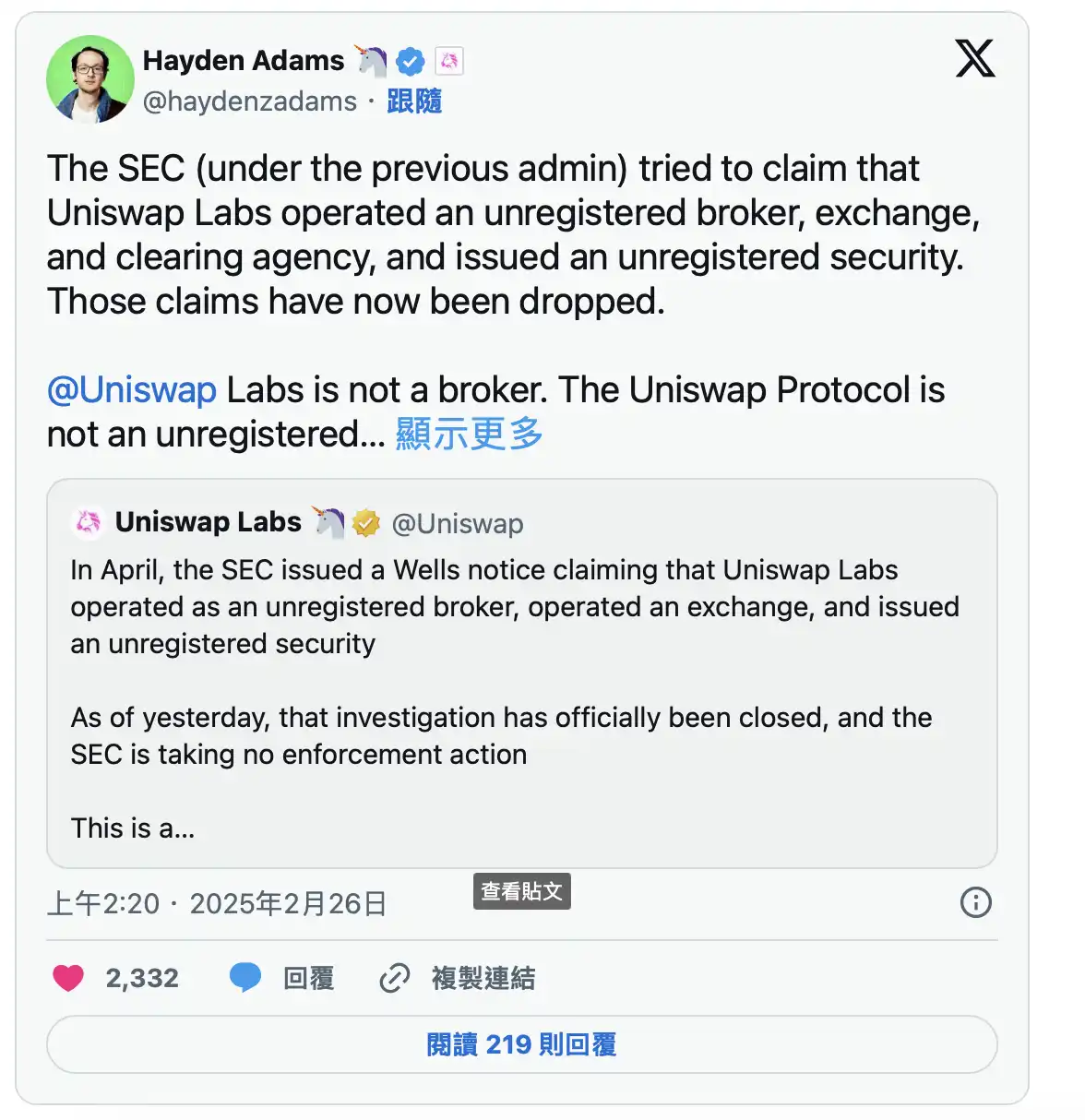
In response to this, Uniswap co-founder Hayden Adams wrote a post detailing how the SEC (previous administration) conducted an investigation that lasted 3 years, forcing them to spend countless hours and millions of dollars, and even brought personal stress. He pointed out:
The intrusive and high-pressure nature of the federal investigation, to the extent that there is a legal saying in the legal world: "The investigation itself is the punishment." But this should not be the cost that American innovators have to bear.
He emphasized that Uniswap Labs is not a broker, the Uniswap protocol itself is not an unregistered exchange or clearinghouse, and Uniswap Labs does not operate it. In addition, the UNI token is not a security.
However, the SEC still took enforcement action against Uniswap Labs, even without clear legal grounds, attempting to arbitrarily enforce DeFi into a regulatory framework that is inconsistent with its essence, while at the same time not providing clear rules or compliance pathways.
Today, these SEC charges have been dropped, leading him to state that this victory belongs to the entire DeFi ecosystem:
"This once again proves our long-standing position: decentralized technologies and self-custody are fundamentally different from the centralized intermediary systems they seek to replace."
He further pointed out that self-custody funds operate on the public chain through smart contracts, bringing unprecedented transparency to the financial market. It is simply not viable to directly impose a regulatory framework applicable to the centralized, opaque traditional financial market (TradFi) on DeFi.
Finally, Adams expressed gratitude to the new SEC leadership for taking a more constructive regulatory approach and looks forward to future cooperation to ensure that DeFi can thrive in the United States rather than be forced to move overseas.
You may also like

Morning Report | OpenAI has submitted an S-1 registration statement draft to the U.S. SEC; Morpho completes $175 million financing

Galaxy Deep Research Report: How Hyperliquid's HIP-4 Upgrade Changes the Landscape of Prediction Markets?

Latest research from 13 top universities including Cornell University: The current state, challenges, and misconceptions of the fusion of Crypto and AI

Deconstructing Anthropic: The Best AI Company, Possibly Also a Type of Organizational Invention

Every exchange is a "Universal Exchange."

The counterattack of traditional finance: Alliance chains are quietly reviving
Pantera Capital Partner: How Tokenization is Restructuring the Private Equity and Early Investment Ecosystem?

Mastercard Launches Agent Pay for AI, Plans to Record AI Agent Payment Authorizations on Polygon
Mastercard launched Agent Pay for AI, a new payment protocol designed to help AI agents make small payments such as pay-per-use access to data and APIs. The system plans to record human-granted AI agent permissions on Polygon, focusing on verifiable authorization, identity, and payment controls.

Curve Deploys Llamalend v2 on Optimism With 250,000 OP Incentives
Curve launched Llamalend v2 on Optimism with 250,000 OP incentives from the Optimism Foundation. The upgrade expands Llamalend beyond its earlier crvUSD-focused model, adding broader collateral support, LlamaRisk market reviews, and the ability to use Curve LP tokens as collateral.

Raydium Old Liquidity Pool Reportedly Exploited, With $1.34 Million Moved to Ethereum and Tornado Cash
An old Raydium liquidity pool was reportedly exploited for around $1.34 million in USDC, RAY, and wSOL, with the stolen funds bridged to Ethereum and deposited into Tornado Cash. The incident highlights the tail risks of legacy DeFi pools, old contracts, and cross-chain fund laundering paths.
Kalshi Executive Challenges “SBF Backed AI Unicorns” Narrative, Says Leopold Aschenbrenner Was Key Figure
Kalshi executive John Wang questioned the “SBF backed AI unicorns” narrative, saying Leopold Aschenbrenner was the key figure behind major AI investment decisions.

New York Proposes Stricter Stablecoin Issuer Rules Aligned With Federal GENIUS Act
NYDFS proposed stricter stablecoin issuer rules aligned with the GENIUS Act, covering reserves, custody, redemption timelines, audits, and capital buffers.

CryptoQuant Says Bitcoin Profitable Supply Is Near 45% Pressure Zone as On-Chain Data Points to Market Repricing
CryptoQuant said Bitcoin’s profitable supply is nearing the 45% pressure zone, signaling rising market stress, unrealized losses, and a possible on-chain repricing phase.

Bitcoin Falls Below 200-Week Moving Average as On-Chain Data Shows Over Half of Supply in Loss
Bitcoin dropped below its 200-week moving average as on-chain data showed over 50% of circulating supply is now in loss, signaling rising market stress.

CFTC Reportedly Plans New Prediction Market Rules Focused on Manipulation Risk and Public Interest Review
The CFTC is reportedly preparing new prediction market rules focused on manipulation risk, public interest review, and retail trader protections.

Meet the new WEEX trial fund—your gateway to greater profits

WEEX Labs Lands at Dutch Blockchain Week: A Disruptive Crypto × AI Conversation Sets Sail in Amsterdam
SK Hynix Reportedly Plans U.S. ADR Listing as Early as August, With SEC Approval Possible in Late June
SK Hynix may pursue a U.S. ADR listing as early as August, with SEC approval reportedly possible in late June amid strong AI chip supply chain demand.
Morning Report | OpenAI has submitted an S-1 registration statement draft to the U.S. SEC; Morpho completes $175 million financing
Galaxy Deep Research Report: How Hyperliquid's HIP-4 Upgrade Changes the Landscape of Prediction Markets?
Latest research from 13 top universities including Cornell University: The current state, challenges, and misconceptions of the fusion of Crypto and AI
Deconstructing Anthropic: The Best AI Company, Possibly Also a Type of Organizational Invention
Every exchange is a "Universal Exchange."
The counterattack of traditional finance: Alliance chains are quietly reviving


